
Table of Contents
- What You'll Need Before You Travel
- How to Store Expressed Breast Milk When Out
- How Long Breast Milk Stays Cold in a Cooler Bag
- How to Travel With Prepared Baby Formula
- Choosing the Best Cooler Bag for Breast Milk
- Step-by-Step: How to Keep Baby Milk Cold During Your Journey
- Common Mistakes to Avoid
- Frequently Asked Questions
Last Updated: October 13, 2026
What You'll Need Before You Travel
Keeping baby milk cold while travelling takes planning and the right equipment. Gather everything before you leave so you're not scrambling at the airport or in the car.
Here's what to pack:
- An insulated cooler bag or soft-sided cooler designed for travel
- Frozen gel packs or ice packs (freeze these the night before)
- Milk bottles or storage bags for expressed breast milk
- A thermometer to check temperature during your journey
- Leakproof containers to prevent spills
- Extra nappies and wipes for cleanup if leaks happen
The goal is simple: maintain a cold temperature throughout your trip. Most milk stays safe between 0°C and 4°C; above 20°C, bacteria multiply quickly.
At Bub and Co, we know travelling with a baby means juggling multiple priorities. Our stain-resistant, easy-to-clean silicone feeding products are designed to simplify mealtime and cleanup for busy parents.
How to Store Expressed Breast Milk When Out
Expressed breast milk needs careful handling away from your usual fridge. Temperature control is everything.
Breast milk can sit safely at room temperature (around 20-25°C) for up to four hours. However, this window closes quickly in warm weather or on long flights.
In an insulated cooler bag with ice packs, expressed breast milk stays safe for up to 24 hours, provided cold air surrounds the bottles or storage bags completely.
Storage tips:
- Place ice packs on the bottom and sides of your cooler, not directly touching the milk
- Use a layer of cloth or newspaper between ice packs and bottles to prevent freezing
- Pack milk bottles upright to prevent leaks
- Label each bottle with the date and time it was expressed
- Keep the cooler closed as much as possible during travel
By car, store the cooler on the floor in the shade, never on a sunlit seat.
How Long Breast Milk Stays Cold in a Cooler Bag
It depends on three things: your cooler's quality, how well you pack it, and the outside temperature. Here's what actually drives the number.
The temperature thresholds that matter
- 0°C to 4°C: the safe chilled range. Milk held here is stable for the full cooler window.
- 4°C to 15°C: still cold, but the clock is running faster. Aim to use or re-chill within a few hours.
- 15°C to 20°C: use within one hour. This is a warning zone, not a safe holding zone.
- 20°C and above: discard. Bacteria multiply rapidly and the milk is no longer safe.
What the 24-hour figure assumes
A quality insulated cooler bag with fully frozen gel packs, packed so cold air surrounds the milk and opened only occasionally, holds expressed breast milk safely for up to 24 hours, the best case.
How to monitor temperature properly
- Use a basic dial or digital probe thermometer.
- Place it in the centre of the cooler, among the bottles, not against the ice pack, which reads artificially low.
- Check every two to three hours and note the reading; a rising trend tells you more than a single number.
- Above 15°C, use the milk within the hour. At 20°C or higher, discard it.
Backup plan for long trips and layovers
For journeys longer than the cooler's effective cooling period, build in a re-chill stop:
- Before departure: freeze more gel packs than you need and pack spares in a separate insulated pouch.
- At the airport: ask cabin crew or ground staff about galley fridge or crew area storage; many airports have family rooms with fridge access.
- At hotels: ask reception to freeze spare gel packs overnight.
- On the road: service stations or restaurants will often swap thawed packs for frozen ones or hold your cooler briefly.
- Worst case: if you cannot re-chill and the temperature has risen above 20°C, discard the milk.
Positioning and packing for maximum cold time
- Put frozen gel packs on the bottom, sides, and top, not just the bottom.
- Use a thin cloth or newspaper barrier between ice packs and bottles to prevent freezing.
- Pack bottles upright with a small gap between them so cold air circulates.
- Keep the cooler closed; every opening lets cold air out and warm air in.
- Store it on the floor in the shade during car travel, never on a sunlit seat.
For current advice, check guidance from your state or territory health department and the Australian Breastfeeding Association's travel resources.
How to Travel With Prepared Baby Formula
Prepared formula follows stricter rules than expressed breast milk, and they differ depending on whether you carry ready-to-feed liquid, powder, or formula mixed at home.
The core limits
- Prepared formula (powder mixed with water): safe at room temperature for a maximum of two hours. After two hours it must be refrigerated at 4°C or below, or discarded.
- Ready-to-feed formula: once the container is opened, treat it like prepared formula, two hours at room temperature, then refrigerate or discard. Unopened ready-to-feed cartons keep according to the pack date and do not need cooling until opened.
- After a feed begins: any formula left in the bottle after your baby has started feeding should be discarded within one hour. Saliva introduces bacteria, and this milk cannot be saved, refrigerated, or re-offered.
- Refrigerated prepared formula: use within 24 hours if stored at 4°C or below. Do not freeze prepared formula, freezing can separate the fat and affect texture and safety.
Powder versus ready-to-feed for travel
Powder is lighter but must be mixed with safe water.
Mixing on the move
If you are mixing powder during travel:
- Use water boiled and cooled to room temperature, or sealed still water you boil and cool if unsure of its source. Never use unpurified tap water in unfamiliar locations.
- Add powder to water, not water to powder, and shake until dissolved.
- Prepare only what you need for the next feed; a batch to "last the journey" defeats the two-hour rule.
- Sterilise bottles and teats before departure, or use pre-sterilised disposable liners.
Warming safely
Warm formula by standing the bottle in warm water, or ask cabin crew for hot water to sit it in.
Cooler storage for formula
In a well-packed insulated cooler with frozen gel packs, prepared formula stays safe for up to 24 hours if the internal temperature stays at 4°C or below.
For current advice, check guidance from your state or territory health department and the Australian Breastfeeding Association's travel resources.
Choosing the Best Cooler Bag for Breast Milk
An insulated cooler bag is your most important tool. The right bag makes the difference between milk staying cold and milk spoiling.
Look for these features:
- Thick insulation: At least 2-3 cm of insulation material keeps cold in longer
- Leakproof design: A sealed interior prevents melted ice from dripping on your milk
- Size that fits your needs: Compact for short trips, larger for long journeys with multiple bottles
- Easy to clean: Removable liners or wipeable interiors prevent mould and odours
- Durable construction: You'll use this bag many times, it needs to withstand travel wear
Soft-sided cooler bags are lighter and fit easily in nappy bags or under airplane seats; hard coolers insulate better but take up more space. For frequent travellers, a dedicated milk cooler bag, designed for bottles and storage bags, with organising compartments, is worth the investment.
Step-by-Step: How to Keep Baby Milk Cold During Your Journey
Step 1: Prepare Your Cooler Before Departure
Start the night before: freeze gel packs completely, since a partially frozen pack won't cool milk enough for long journeys. Wipe the cooler interior with a damp cloth and let it dry fully, moisture reduces insulation.
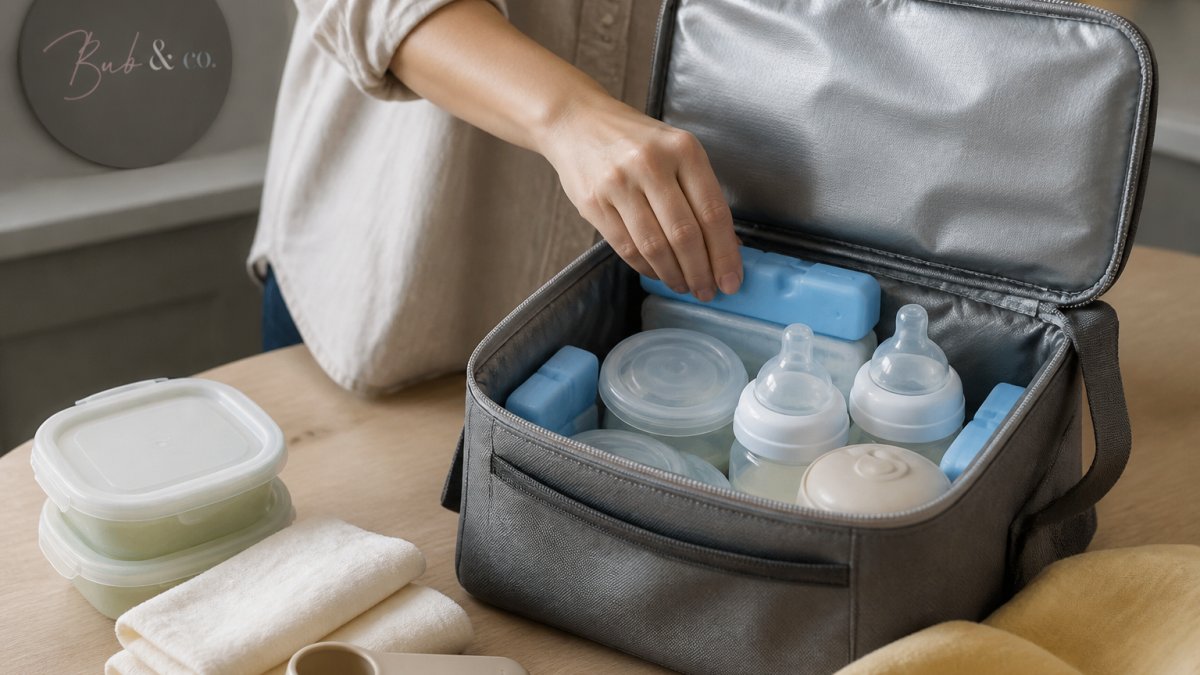
Step 2: Pack Ice Packs and Gel Packs Correctly
Use multiple ice packs on the bottom, sides, and top to surround your milk completely. Frozen gel packs beat loose ice because they don't melt onto bottles; if you use ice, seal it in bags. For trips over 12 hours, pack extras to swap out as they thaw, and ask flight crew or hotel staff to freeze spares.
Step 3: Arrange Milk Bottles and Storage Bags Securely
Pack bottles upright in the centre, surrounded by ice packs, never on their side, where milk can leak from the teat or seal. Stack storage bags flat in the middle, surrounded by cold packs and not too high, to avoid pressure leaks. Leave a small gap between bottles so cold air circulates; a tightly packed cooler cools less effectively.
Step 4: Monitor Temperature During Travel
Check the internal temperature every two to three hours with a simple thermometer, verifying it stays below 4°C. Above 15°C, use the milk within about an hour; at 20°C or higher, discard it. On flights, ask cabin crew to store the cooler in a galley or crew area, which stays cooler than the cabin.
Step 5: Handle Layovers and Long Stops
During layovers, keep the cooler closed, every opening lets cold air escape. For layovers over two hours, ask airport staff or your airline to refrigerate it temporarily; many family rooms and lounges have fridge access. On car journeys, keep the cooler in the shade, never in direct sunlight or a parked car, and ask restaurants to refrigerate your milk during meal stops.
Common Mistakes to Avoid
Opening the cooler too often: Cold air escapes each time. Plan access and minimise opening.
Placing ice packs directly against bottles: This can freeze milk or damage bags.
Ignoring temperature limits: Breast milk has a four-hour room-temperature limit; prepared formula has two hours.
Leaving the cooler in a hot car: A parked car becomes an oven within minutes.
Keeping baby milk cold while travelling is manageable with planning and the right equipment.
At Bub and Co, we know travelling with a baby means managing multiple tasks at once. Our stain-resistant, durable silicone feeding products make cleanup easier away from home.
Get started with Bub and Co's feeding sets and discover how quality silicone products simplify mealtime.
Frequently Asked Questions
Can babies drink cold breast milk straight from the cooler?
Yes, babies can drink cold breast milk safely. Many babies happily accept milk at room temperature or chilled. If your baby prefers warm milk, you can warm the bottle using warm water from a thermos or by running it under warm tap water at your destination. Cold milk won't harm your baby and can be especially soothing for teething infants.
How long can breast milk stay cold in a cooler bag with ice packs?
Breast milk can stay safe in an insulated cooler bag with ice packs for up to 24 hours, provided the cooler maintains a temperature between 0°C and 4°C. The duration depends on cooler quality, ice pack quantity, and how often you open the bag. Check ice packs regularly and replace them if they've thawed.
What's the safest way to travel with prepared baby formula?
Pack prepared formula in sterilised bottles or storage bags and place them immediately into your insulated cooler bag with frozen gel packs or ice. Keep the cooler at 4°C or below. For journeys under 2 hours, room temperature is acceptable if the formula was recently prepared. For longer trips, use cooler bags and ice packs. Never leave prepared formula unrefrigerated for more than 2 hours.
How do I choose the best cooler bag for breast milk and formula?
Select an insulated cooler bag designed to maintain cold temperatures for extended periods. Look for thick insulation, a secure seal, and leakproof compartments to prevent milk from mixing with melted ice. Soft-sided coolers are portable and lightweight for travel. Ensure the bag is easy to clean and fits your packing needs. Test it with ice packs before your trip to confirm it maintains safe temperatures throughout your journey.
Leave a comment