
Table of Contents
- What Makes a Teether Good for Motor Development
- Quick Comparison: Sensory Teething Toys at a Glance
- Koala Teethers: Best for Gripping and Hand-to-Mouth Practice
- Ring Teether: Best for Reaching and Grasping
- Banana Teether: Best for Early Sensory Exploration
- Silicone and Wood Teethers: Best for Texture Variety
- Baby Teether Safety and Cleaning: What to Check Before Every Use
- How to Choose the Best Baby Teether for Your Baby's Stage
- Frequently Asked Questions
Last Updated: October 14, 2026
What Makes a Teether Good for Motor Development
The best sensory teething toys for motor development are lightweight, easy to grip, and shaped so a baby can hold, reach for, and bring them to the mouth without help.
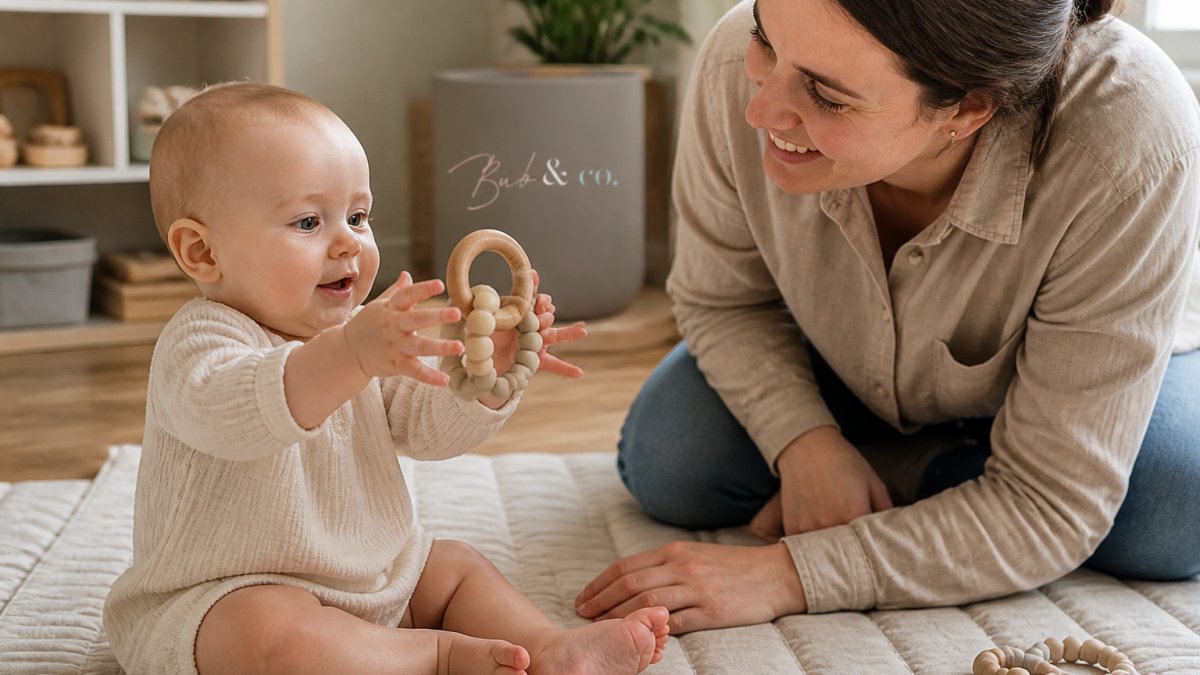
That second job matters more than most parents realise. Reaching, grasping, holding, and transferring an object between hands are early fine motor skills, and they build through repetition.
Quick Comparison: Sensory Teething Toys at a Glance
Here is how our current teethers compare on shape, material, and price, so you can match one to your baby's stage.
| Teether | Price | Material | Best For |
|---|---|---|---|
| Koala Teether | $14.95 | Silicone and wood | Gripping and hand-to-mouth practice |
| Ring Teether | $14.95 | Food-grade silicone | Reaching and grasping |
| Banana Teether | $11.99 | Food-grade silicone | Early sensory exploration (3+ months) |
| Silicone & Wood Teether | $14.95 | Silicone and wood | Texture variety |
| Star Teether | $9.95 | Food-grade silicone | A lightweight spare for the pram |
| Helm Silicone Teether | $14.95 | Food-grade silicone | Oral development during teething |
| Flower Silicone Teether | $14.95 | Food-grade silicone | Simple one-piece chewing |
| Mix & Match Teether Bundle | $30.00 | Food-grade silicone | Three teethers, one for each bag |
Every teether above is free from BPA, PVC, and phthalates, and the bundle is tested and compliant with AS/NZS ISO 8124 safety standards for toys.

Koala Teethers: Best for Gripping and Hand-to-Mouth Practice
Our top pick for grip practice is the Koala Teether, which pairs untreated wood for handling with food-grade silicone for chewing.
The hand-to-mouth motion is one of the first coordinated movements a baby learns, and it takes months of repetition. A teether with a clear handle makes it easier: the baby holds one end and aims the other at the mouth.
A slippery teether teaches nothing: if the whole toy is soft and wet, there is nothing to grip.
The Koala Teether is $14.95, and like all our children's products it should be used under parental supervision at all times.
Ring Teether: Best for Reaching and Grasping
The Ring Teether is the strongest option for reaching and grasping because its open shape can be hooked, swiped at, and held from any angle.

Reaching develops before grasping: a baby first bats at an object, then closes a whole hand around it, then uses a pincer grip much later.
The surface is textured to stimulate sore gums, and the bright colours give your baby something to track with their eyes.
It is also dishwasher safe, and a few minutes in the fridge gives extra relief on inflamed gums.
The Ring Teether is $14.95, and we recommend it for babies 3 months and over.
Banana Teether: Best for Early Sensory Exploration
For babies just starting to explore with their mouths, the Banana Teether is our pick.

The banana shape is a genuine advantage: narrow enough to reach the back of the mouth where molars eventually appear, but soft enough not to press hard on tender gums.
It is a single-material teether, so it offers less texture variety than a silicone and wood design, but for a first teether, that simplicity is usually right.
The Banana Teether is $11.99.
Silicone and Wood Teethers: Best for Texture Variety
Texture variety is where silicone and wood teethers pull ahead.
Variety keeps a baby interested, and interest drives repetition: a one-texture teether gets abandoned sooner than one with a dry wooden side and a soft silicone side.
Our silicone and wood teethers, including the Koala Teether, are non-toxic and free from BPA, PVC, and phthalates, and each is $14.95. If you want to test which texture your baby prefers before committing, the Star Teether is a lighter silicone option at $9.95.
Baby Teether Safety and Cleaning: What to Check Before Every Use
Baby teether safety and cleaning comes down to a short inspection before each use and a proper wash after.
A three-point check takes seconds:
- Squeeze the teether to confirm it is one piece with no loose parts
- Run a finger along every edge for cracks, splits, or rough spots
- Check wooden sections for splintering or separation from the silicone
Choking risk rises with small detachable parts, so a one-piece design is safer than anything that clips or screws together. Our teethers are single-piece by design.
On cooling: the fridge is the right place, not the freezer. A few minutes in the fridge gives gentle relief, while a frozen teether can be too hard on delicate gums.
How we assess a teether before recommending it
Here is the method we use, the same checks you can run on any teether you already own:
- Grip: Can a baby close a whole hand around it, and does it stay put when the palm is wet with saliva? A teether that slips out of a wet hand is not being practised with.
- Weight: Can it be lifted and controlled one-handed by a baby at the lower end of its stated age range? If not, the age guidance is optimistic.
- Texture: Are there at least two distinct surfaces (for example, a firm dry section and a soft chewable section), or is it uniform? Uniform texture is fine for a first teether but offers less to explore.
Material-specific care
Different materials fail in different ways:
- Food-grade silicone: Dishwasher-safe on the top rack, and can be chilled in the fridge (not the freezer). Inspect for tiny tears at the edges and around any moulded texture, because a split can widen with chewing. Replace silicone that has gone sticky or developed a persistent odour after washing.
- Untreated wood: Wipe or hand-wash and dry immediately. Do not soak wood or leave it wet, because moisture raises the grain and can lead to cracking or splintering. A food-safe oil can be reapplied if the wood looks dry, but check the manufacturer's instructions first.
- Mixed silicone and wood: The join is the weak point. Check after every wash that the wood has not lifted away from the silicone, because a gap can trap moisture and harbour bacteria.
When to replace a teether
A teether is not a lifetime purchase. Replace it when any of these appear:
- Cracks, splits, or tears in the silicone
- Splintering, rough patches, or separation on wooden sections
- A persistent smell or a surface that stays tacky after washing
A teether used daily through the heaviest teething weeks will often show visible wear within a few months. Keeping a spare in rotation means you can retire a worn teether immediately.
How to Choose the Best Baby Teether for Your Baby's Stage
Choosing the best baby teether starts with your baby's current motor stage, not their age alone. Match the shape to what they can already do, then step up as their grip develops.
Use this as a starting point:
- Around 3 to 4 months, just batting and mouthing: a light silicone teether such as the Banana Teether, held for them at first
- Around 4 to 6 months, whole-hand grasping: the Ring Teether, which can be grabbed from any angle
- Around 6 months and beyond, transferring between hands: a silicone and wood teether such as the Koala or Paw Print, which gives two surfaces to explore
Which motor skill does each teether feature actually practise?
The more useful question is which specific action a teether encourages, because that determines whether it supports development or just sits in the drawer. The table below maps common features to the motor actions they make possible.
| Teether feature | Motor action it encourages | What it does not do |
|---|---|---|
| Open ring shape | Swiping, hooking, and whole-hand grasping from any angle | Builds pincer grip, which comes later and needs smaller objects |
| Short handle or stem | Aimed reaching and controlled hand-to-mouth movement | Teaches two-handed play on its own |
| Two distinct materials | Transferring between hands and comparing textures | Replaces the need for varied toys across the day |
| Lightweight single piece | Lifting and holding one-handed | Builds strength for heavier objects |
| Textured chewable end | Mouthing and jaw movement | Develops chewing for solids, which needs practice with food |
A teether can support practice of a movement a baby is already attempting, but it does not create a milestone ahead of schedule.
Matching the teether to your baby, not just their age
Two babies of the same age can have very different sensory preferences and grip strength. A few adjustments cover most variation:
- Babies who prefer less stimulation: choose a single-colour, single-texture teether rather than a bright, multi-textured one. A calmer object is more likely to be picked up by a baby who is easily overwhelmed.
- Babies with a weaker grip: favour a lighter teether with a wider handle, and offer it handle-first into the palm rather than holding it out of reach.
- Babies who reject soft silicone: try a firm wooden section or a chilled silicone teether, since temperature and firmness change the mouth feel considerably.
Offering two or three shapes is the fastest way to find what suits your baby, which is why the Mix & Match Teether Bundle lets you pick any three teethers for $30, one at home, one in the nursery bag, one in the pram.
Teethers versus other motor-development toys
A teether is one tool among several:
- Teethers are strongest for mouthing, hand-to-mouth movement, and early grasping, because a teething baby is strongly motivated to put them in their mouth. That motivation makes the practice self-reinforcing during the fussiest weeks.
- Rattles add sound and cause-and-effect, which encourages a baby to repeat a shake and to track the object with their eyes.
- Soft cloth books and baby-safe mirrors encourage reaching, batting, and visual tracking without the mouthing focus.
A teether covers the mouthing-and-grasping stage well, but it does not replace a small toy rotation. A teether, a rattle, and a cloth book together give a baby more to practise than any one alone.
A quick word on the wider kit. If you are also starting solids, our Breakfast, Lunch & Dinner Pagi Bundle includes three complete feeding sets plus a free suction plate for $79 with free delivery, and every bundle includes a free silicone teether while stocks last.
Frequently Asked Questions
What is the best baby teether for motor development?
The best baby teether for motor development combines a shape that's easy for small hands to hold with textures that encourage mouthing and exploration. Ring-shaped teethers like the Ring Teether ($14.95) are ideal for reaching and grasping, while wooden and silicone combination teethers such as the Koala Teethers ($14.95) offer varied textures that build hand strength and sensory awareness.
What age can you start using teething toys?
Most teethers are suitable from 3 months and up, once your baby can bring objects to their mouth. The Banana Teether is recommended for babies 3+ months, while other Bub and Co teethers like the Ring Teether are designed for babies 3 months+ experiencing teething. Always supervise your baby during use and check the teether for wear before each use.
Are silicone teethers safe for babies?
Food-grade silicone teethers are safe when they're free from BPA, PVC, and phthalates. Bub and Co teethers are made from 100% food-grade silicone. Check for small detachable parts, inspect regularly for cracks or tears, and always supervise your baby while they use a teether.
How do you clean and inspect a baby teether?
Wash teethers before first use and after each use with warm soapy water or place them in the top rack of the dishwasher. Inspect regularly for cracks, tears, or loose parts, and discard any teether that shows signs of wear. Avoid boiling silicone teethers or using abrasive cleaners.
How can teething toys support a baby's motor development?
Teething toys support motor development by giving babies repeated practice at reaching, grasping, holding, and transferring objects between hands. Textured surfaces encourage mouthing, which builds tongue and jaw muscles. Lightweight, easy-grip designs like the Ring Teether help babies build fine motor skills while soothing sore gums.
Leave a comment