
Table of Contents
- Why Verifying Silicone Quality Matters for Baby Products
- The Pinch and Twist Test: What It Does and Does Not Tell You
- Signs of Low Quality Silicone: Visual and Tactile Checks
- Simple Home Tests: Odour, Temperature and Combustion
- Silicone Safety Standards Australia: Certification Labels to Look For
- Food Grade Silicone vs Plastic: How to Tell the Difference
- Chemical Leaching and Lifecycle: What Home Tests Cannot Detect
- How to Verify Silicone Quality Before You Buy
- Frequently Asked Questions
Last Updated: September 8, 2026
When a silicone teether goes into a baby's mouth, the material's quality matters more than its colour or shape. Food-grade silicone is a polymer made from silica and oxygen, and its safety depends on the purity of that polymer and how it was cured. We regularly hear from parents who want to know how to verify silicone quality before they trust a product with their child.

The honest starting point is this: the most reliable way to verify silicone quality is checking for recognised third-party certification, because the physical tests below can only reveal some problems. They catch obvious flaws, but they cannot measure chemical safety.
Why Verifying Silicone Quality Matters for Baby Products
Silicone sits in a baby's mouth for extended periods during teething and feeding, which makes material purity a genuine health consideration. Low-grade silicone can contain fillers, unreacted compounds, or synthetic rubber blends that may leach substances over time, particularly when exposed to heat or acidic foods.
Quality matters because cheap fillers change how the material behaves. A product that feels greasy, smells chemical, or turns white when stretched often contains additives that should not be there. These issues are not always visible at purchase.
The stakes are higher for babies than for adults using kitchen tools. Babies chew with more force relative to their size and are still developing, so the material needs to be genuinely non-toxic and durable. Australian Competition and Consumer Commission guidance on product safety notes that parents should look for products meeting recognised safety standards for children's items.
The Pinch and Twist Test: What It Does and Does Not Tell You
The pinch and twist test is the most commonly cited home check, and it does have value, but its limits are widely misunderstood.
To perform it, pinch the silicone between your thumb and forefinger, twist it firmly, and watch the surface. High-quality silicone appears opaque white at the pinch point and springs back to its original shape immediately. If the material shows no colour change, feels rubbery like a car tyre, or stretches thin without whitening, it likely contains synthetic rubber or fillers.
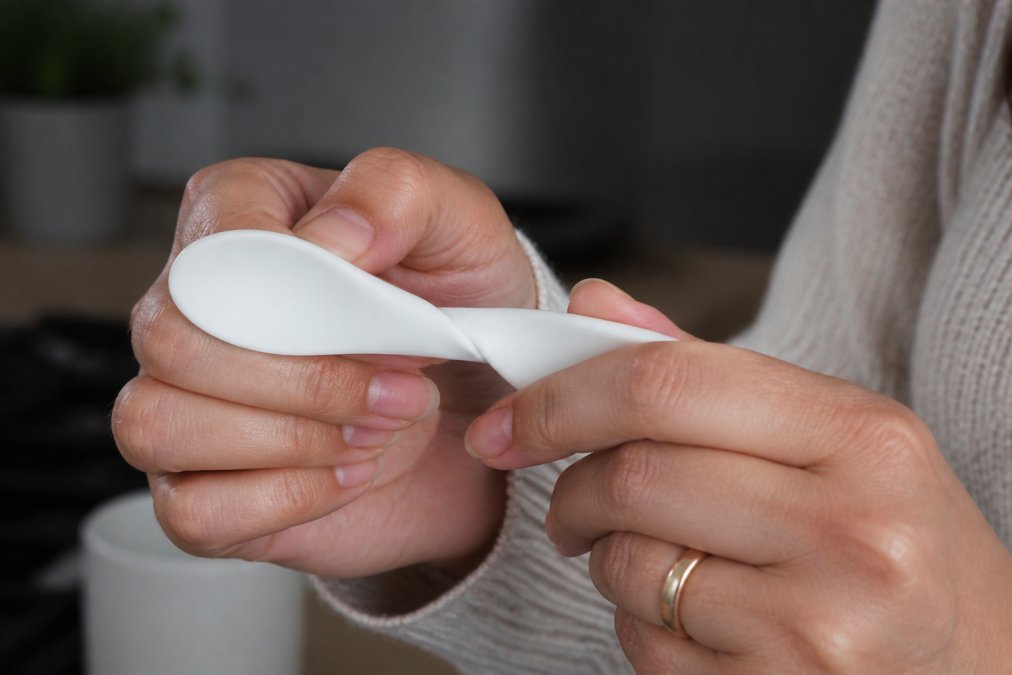
The pinch test only checks for one type of filler, so treat it as a screening tool, not proof of safety.
Signs of Low Quality Silicone: Visual and Tactile Checks
Before any twisting begins, a simple visual inspection reveals a great deal about signs of low quality silicone.
Food-grade silicone should appear smooth, uniform, and slightly matte. Low-quality material often shows moulding flaws, rough edges, or an uneven finish where fillers have created lumps. Translucency matters too: pure silicone is naturally somewhat translucent, while heavily filled material looks flat and opaque.
The tactile check is equally telling. Run your finger across the surface and press into the material. Genuine food-grade silicone feels soft, warm to the touch, and has a slight grip. If the surface feels slippery, tacky, or leaves any residue on your fingers, that is a red flag.
Cracks, bubbles, or visible seams indicate poor manufacturing.
Simple Home Tests: Odour, Temperature and Combustion
Three further home tests help confirm what your eyes and fingers suggest, though each has specific limitations.
The odour test is straightforward. Wash the product with mild soap and warm water, then smell it immediately. High-quality silicone should have no smell at all. A strong chemical or plastic odour indicates low-grade material or contamination. Some new silicone products have a faint neutral scent that fades after the first wash, so test after cleaning.
The temperature test checks thermal stability. Pour boiling water over the product and let it sit for a minute. Quality silicone remains unchanged in shape, colour, and flexibility. If it warps, softens excessively, or releases an odour, the material is not pure.
The combustion test is the most dramatic but should be done with caution and good ventilation. Hold a small corner of the material with metal tongs and apply a flame briefly. Quality silicone burns with a white smoke and leaves a fine white ash, similar to sand. Material containing fillers or rubber burns with black smoke and leaves a sticky, dark residue. Food Standards Australia New Zealand information on food contact materials provides context on why material composition matters for items touching food.
Silicone Safety Standards Australia: Certification Labels to Look For
Home tests have their place, but the silicone safety standards Australia relies on are the strongest indicator of quality. Certification labels tell you a product has been independently tested, which no home check can replicate. However, not all labels are equal, and not all claims are genuine.
The Two Certifications That Matter Most
Two certifications dominate the market for food-contact silicone, and they test different things.
LFGB compliance originates from the German Food and Feed Code (Lebensmittel- und Futtermittelgesetzbuch). It is widely considered the stricter standard because it uses a broader range of food simulants and migration tests. An LFGB test report for silicone typically includes checks for:
- Overall migration into aqueous and fatty food simulants
- Specific migration of heavy metals like lead, cadmium, and mercury
- The presence of volatile organic compounds (VOCs) and peroxides
- Sensory testing, which means the material must not impart any odour or taste to food
FDA certification (from the United States Food and Drug Administration) confirms the material meets the Code of Federal Regulations (21 CFR 177.2600) for rubber articles intended for repeated food-contact use. This standard sets limits on extractable substances under specific conditions, but its testing protocol is generally narrower than LFGB's sensory and migration suite.
For baby products, a third framework matters: the Australian mandatory safety standard for children's goods (Consumer Goods (Products for Children) Safety Standard). This standard addresses physical hazards like choking, small parts, and sharp edges. It does not test chemical migration, so it complements rather than replaces LFGB or FDA certification.
How to Verify a Certification Claim
A label claiming LFGB or FDA compliance is only as good as the documentation behind it. Here is how to check whether the claim is real:
- Ask for the test report. Legitimate manufacturers have a laboratory report from an accredited third-party lab (such as SGS, TÜV, or Intertek) that names the specific product and the standard tested against. A vague claim without a report is a red flag.
- Check the report's date and product name. The report should be current (within the last few years) and should reference the exact product you are buying, not a generic material sample.
- Look for the specific standard cited. A genuine LFGB report will reference § 31 of the German Food and Feed Code or the specific migration test methods (e.g., EN 1186 for overall migration). A genuine FDA claim will reference 21 CFR 177.2600.
- Be wary of self-declared labels. Some brands print "LFGB-grade" or "FDA-grade" without third-party testing. If the brand cannot produce a report on request, treat the claim as marketing, not certification.
Why Certification Outperforms Home Tests
Certification matters because it measures what home tests cannot: chemical migration under realistic use conditions. A laboratory test simulates months of exposure to heat, acidic food, and saliva in a matter of days. It can detect unreacted oligomers, residual catalysts, and filler migration at parts-per-million levels. No pinch test or burn test comes close to that sensitivity.
When a product carries a verifiable LFGB or FDA certificate, you can trust its chemical safety. When it does not, you are relying on the brand's word and your own home tests, which only catch physical flaws.
Standards Australia information on materials in contact with food outlines the broader framework for food-contact material safety, and Food Standards Australia New Zealand information on food contact materials provides context on why material composition matters for items touching food. Both are useful background, but neither replaces the specific LFGB or FDA test report for the product in your hand.
Food Grade Silicone vs Plastic: How to Tell the Difference
Parents often ask how to tell food grade silicone vs plastic apart, especially since some plastic products are designed to mimic silicone's softness.
Silicone has a distinctive soft, slightly grippy feel that warms to room temperature quickly. Plastic feels cooler and harder, even when flexible. Squeeze the product: silicone compresses evenly and returns slowly, while flexible plastic tends to resist or snap back faster.
The stretch test helps here too. Silicone stretches significantly and returns to its exact original shape without distortion. Plastic stretches less and may develop a white stress mark or permanent deformation.
Heat is a decisive differentiator. Silicone withstands boiling water, oven heat, and freezing without changing. Plastic softens, warps, or releases an odour under high heat. The material composition is fundamentally different: silicone is a silica-based polymer, while plastic is petroleum-based.
| Material | Feel | Stretch Response | Heat Tolerance | Odour After Heating |
|---|---|---|---|---|
| Food-grade silicone | Soft, grippy, warm | Returns to shape fully | Boiling and oven safe | None |
| Flexible plastic | Cooler, harder | May deform or stress-mark | Warps or softens | Chemical or plastic smell |
Chemical Leaching and Lifecycle: What Home Tests Cannot Detect
Here is the honest limitation of every home test: none of them can measure chemical leaching. Detecting whether substances migrate from the material into food or saliva requires laboratory equipment and controlled conditions. Understanding why leaching happens, and when a product has reached the end of its safe life, gives you a framework that no pinch test can provide.
The Chemistry of Leaching: What Actually Migrates
Silicone is a polymer made from silica and oxygen, but the finished product is never just that. The manufacturing process introduces other substances, and their presence determines whether leaching is a concern.
Platinum-cured silicone uses a platinum catalyst to cross-link the polymer chains. This process is considered higher purity because the catalyst remains bound within the material and does not readily migrate.
Peroxide-cured silicone uses organic peroxides as the curing agent. The process is cheaper, but it can leave by-products that are not fully bound to the polymer and can migrate over time, especially when heated or exposed to acidic foods. This is why peroxide-cured silicone is more common in industrial applications than in food-contact products. Beyond the curing agent, other potential migrants include:
- Unreacted oligomers: Short polymer chains that did not fully cross-link during curing. They can migrate into food, especially fatty foods, and are one reason LFGB testing uses oil-based simulants.
- Colourants and pigments: Not all colourants are food-safe. Some contain heavy metals or organic compounds that can leach, which is why certification testing includes specific migration limits for metals.
- Fillers: Silica or other bulking agents added to reduce cost. While silica itself is inert, heavily filled silicone degrades faster because the polymer matrix is diluted.
How to Tell When Quality Silicone Has Reached End of Life
Even the highest-quality platinum-cured silicone does not last forever. The polymer chains slowly break down under repeated heat, UV exposure, and mechanical stress. The key is distinguishing normal wear from premature failure caused by low-quality material.
Signs that quality silicone is degrading (normal end of life):
- A sticky or tacky surface that does not wash off. This indicates the polymer chains are breaking down and releasing low-molecular-weight oligomers to the surface. Once this starts, it will not reverse.
- A chalky white film that reappears after washing. This is often a sign of surface oxidation or filler migration.
- Loss of elasticity. If the material no longer springs back fully after stretching or twisting, the polymer matrix is failing.
- Cracks or tears at stress points, such as where a teether attaches to a ring or where a spoon handle meets the bowl.
Signs that the product was low quality from the start:
- Whitening or stress marks appear after only a few weeks of normal use. Quality silicone should not develop these marks with routine handling.
- A persistent chemical odour that returns after washing. This suggests unreacted by-products are migrating to the surface.
- Surface tackiness develops within the first month. This is premature degradation, not normal wear.
A Practical Inspection Routine
Inspecting silicone feeding products every two to four weeks during active use is a good practice. Here is a simple routine:
- Wash the product with warm soapy water and let it air dry completely.
- Smell it. Quality silicone should have no odour. Any smell, even faint, warrants attention.
- Stretch a non-functional area (like the rim of a bowl) and look for whitening or stress marks.
- Run your finger across the surface. It should feel smooth and slightly grippy, not tacky or slippery.
- Check seams and attachment points under bright light for cracks or thinning.
When to Replace
Quality silicone used daily for feeding typically lasts through one child's teething and weaning phases, roughly 12 to 18 months of regular use. Replace a product if you notice any of the end-of-life signs above, or if it has been in heavy daily use for more than two years, even if it looks fine.
This lifecycle perspective is the angle most guides miss. They tell you how to spot bad silicone at purchase, but not how to recognise when good silicone has served its purpose. By combining certification checks at purchase with a simple monthly inspection, you get the full picture.
How to Verify Silicone Quality Before You Buy
The most effective time to verify silicone quality is before purchase, not after. A few minutes of checking can prevent the hassle of returning an unsafe product.
Look for explicit statements about material composition: "100% food-grade silicone" or "food-grade silicone" with certification claims. Products free from BPA, PVC, and phthalates should state this clearly. Check the product description for details about the curing process, as platinum-cured silicone signals higher purity.
Ask the retailer directly. Reputable sellers should be able to tell you where products are manufactured and whether third-party testing has been done. If a seller cannot answer basic questions about material sourcing or certification, treat that as a warning sign.
Consider the brand's track record. Established brands with a focus on baby safety typically invest in proper certification and quality control. Bub and Co's feeding sets and teethers are made from food-grade silicone, free from BPA, PVC, and phthalates, with stain-resistant and odour-free materials that withstand heat and cold without leaching chemicals.
The practical approach combines all these methods. Use the pinch, visual, and odour tests as quick screens at home. Rely on certification and brand transparency for the chemical safety that home tests cannot assess. Replace silicone products at the first sign of stickiness, cracking, or permanent discolouration.
For parents building a safe feeding collection, the Pagi Kids Feeding Set offers food-grade silicone that withstands temperature extremes without melting or cracking, while the Helm Silicone Teether provides a safe, durable surface for soothing gums. Both are designed to make mealtime and cleanup easier, with materials that resist stains and odours over months of daily use.

Knowing how to verify silicone quality comes down to combining quick home checks with the assurance of proper certification. The tests in this guide catch obvious problems, but they cannot replace independent laboratory testing for chemical safety. That is why Bub and Co builds every product around certified food-grade silicone, free from BPA, PVC, and phthalates. Explore the feeding sets and give your baby a safe, durable start to solid foods.
Frequently Asked Questions
Is the pinch test an accurate way to verify silicone quality?
The pinch and twist test is a useful first check but not conclusive on its own. Twisting a silicone product should leave a white mark that fades quickly, and quality silicone returns to its original shape without tearing. However, some lower-grade fillers can mimic this behaviour. Use the pinch test alongside other checks: look for certification labels such as LFGB compliance, check the surface for imperfections, and consider how the product responds to heat and cold. No single home test can confirm food-grade quality.
What does pure silicone look like?
Pure, food-grade silicone has a consistent surface with no visible pits, bumps or rough edges. It feels soft and slightly grippy, not slippery like plastic. High-quality silicone is often translucent rather than perfectly opaque, which reflects its material purity. If you stretch it, the colour should remain even. Patchy colouring or a cloudy appearance can suggest fillers have been added. Remember that manufacturers can add colour pigments, so white or pastel shades do not automatically mean lower quality.
What should I look for on product labels regarding safety standards?
In Australia, look for labels stating the product is food-grade silicone and free from BPA, PVC and phthalates. Reputable brands reference independent testing against standards such as LFGB (German) or FDA (US) guidelines for food contact materials. These certifications indicate the silicone has undergone laboratory testing for chemical leaching and material purity. If a label only says 'silicone' without specifying food-grade or a testing standard, treat it with caution. Contact the brand directly if certifications are not listed on the packaging or website.
How can I tell if silicone is real versus synthetic rubber or plastic?
Try a combination of tests. Real silicone feels soft and flexible with a slight drag on your fingers, while plastic feels harder and smoother. Silicone is heat resistant: pour boiling water over it and it will not warp or melt, whereas many plastics will soften. When burned with a flame, quality silicone produces white ash and a non-toxic residue, while synthetic rubber or plastic tends to melt, drip or give off dark smoke. The odour test also helps: quality silicone has little to no smell, while lower-grade materials often have a chemical scent.
Leave a comment