
Table of Contents
- The Honest Verdict: Is Baby-Led Weaning Worth It for Busy Parents?
- The Time Cost of Baby-Led Weaning (And Where It Actually Saves You Time)
- Combining Purees and Baby-Led Weaning: The Hybrid Approach for Busy Families
- Essential Baby-Led Weaning Tools That Cut Cleanup Time
- Choking Hazards in Baby-Led Weaning: What Busy Parents Need to Know
- Meal Prep Strategies That Make Baby-Led Weaning Sustainable
- Baby-Led Weaning in Childcare Settings: What to Arrange Before Daycare
- The Downsides of Baby-Led Weaning No One Mentions
- Frequently Asked Questions
Last Updated: September 23, 2026
The Honest Verdict: Is Baby-Led Weaning Worth It for Busy Parents?
If you're weighing up whether baby-led weaning is worth it for busy parents, the honest answer is: yes, but only if you stop treating it as an all-or-nothing method. Baby-led weaning is the practice of offering babies soft finger foods so they feed themselves from the start of solids, rather than being spoon-fed purees. We talk to parents every week who abandoned it in week two, not because their baby couldn't do it, but because the cleanup and cooking load broke them first.
The Time Cost of Baby-Led Weaning (And Where It Actually Saves You Time)
Where the time comes back.
- No separate puree production: no steaming, blending, portioning into ice-cube trays, or defrosting. That's a whole weekly kitchen session gone.
- One cook, one meal: your baby eats a modified version of what you're already making, so you're not running two menus.
- No spoon-feeding performance: you eat your own dinner while your baby eats theirs, instead of spending the meal delivering spoonfuls.
- Fewer later battles: self-feeding builds chewing and hand-eye coordination early, which tends to mean less resistance as textures get harder.
A common mistake is measuring the first three weeks and quitting. Judge it over two months instead.
Combining Purees and Baby-Led Weaning: The Hybrid Approach for Busy Families
The hybrid approach is the single most practical answer for working parents, and it's the angle most guides skip entirely. You offer finger foods for your baby to explore, and you also spoon-feed some iron-rich foods to make sure nutrition keeps up on days when there's no time to prepare a full spread.
How to Split the Load Without Losing the Benefits
- Finger foods at dinner: when you have time to sit and supervise
- Spoon-fed purees at breakfast: fast, iron-fortified, low mess
- Self-feeding snacks: soft fruit, toast fingers, or steamed vegetable sticks
- Weekends for practice: longer, slower meals where texture exploration happens
Your baby still gets feeding autonomy, self-regulation practice, and sensory development. You still get out the door by 7:30am.
A Sample Hybrid Week for a Working Parent
| Day | Breakfast | Lunch (childcare or home) | Dinner |
|---|---|---|---|
| Monday | Spoon-fed iron-fortified cereal | Centre-provided food | Finger foods: roasted pumpkin and chicken strips |
| Tuesday | Toast fingers with spread | Centre-provided food | Finger foods: steamed broccoli and lentil patties |
| Wednesday | Spoon-fed puree | Centre-provided food | Finger foods: soft pasta and cooked carrot |
| Thursday | Yoghurt with a spoon (baby-led) | Centre-provided food | Finger foods: shredded slow-cooked meat and soft pear |
| Friday | Toast fingers | Centre-provided food | Finger foods: well-cooked egg and avocado strips |
| Weekend | Family breakfast, baby self-feeds | Shared lunch, baby self-feeds | Family dinner, baby self-feeds |
This isn't a rigid plan, it's a template. Swap any meal for a spoon-fed one on a rough day and nothing breaks.
The Rules That Keep the Hybrid Honest
- Keep at least one self-fed meal a day. This is what preserves the chewing practice and self-regulation benefits. If every meal is spoon-fed, you've drifted into traditional feeding, which is fine, just know that's the choice.
- Never spoon-feed while your baby is also handling finger food. Do them as separate parts of the meal to avoid confusion and reduce choking risk.
- Let your baby lead the spoon too. Offer a loaded spoon and let them bring it to their mouth when they're ready, rather than you controlling every bite.
- Watch iron, not just volume. Iron-rich foods matter most in the early months, so make sure the spoon-fed meals carry their weight, fortified cereal, pureed meat, lentils, or well-cooked egg.
Why This Beats Picking a Side
Strict BLW can be hard to sustain when you're back at work and childcare is spoon-feeding during the day. Strict spoon-feeding can delay self-feeding skills and make texture transitions harder later. The hybrid gives you the developmental upside of self-feeding without demanding a full-time commitment to it, which is exactly why it's the version most busy families end up running, whether they call it that or not.
Essential Baby-Led Weaning Tools That Cut Cleanup Time
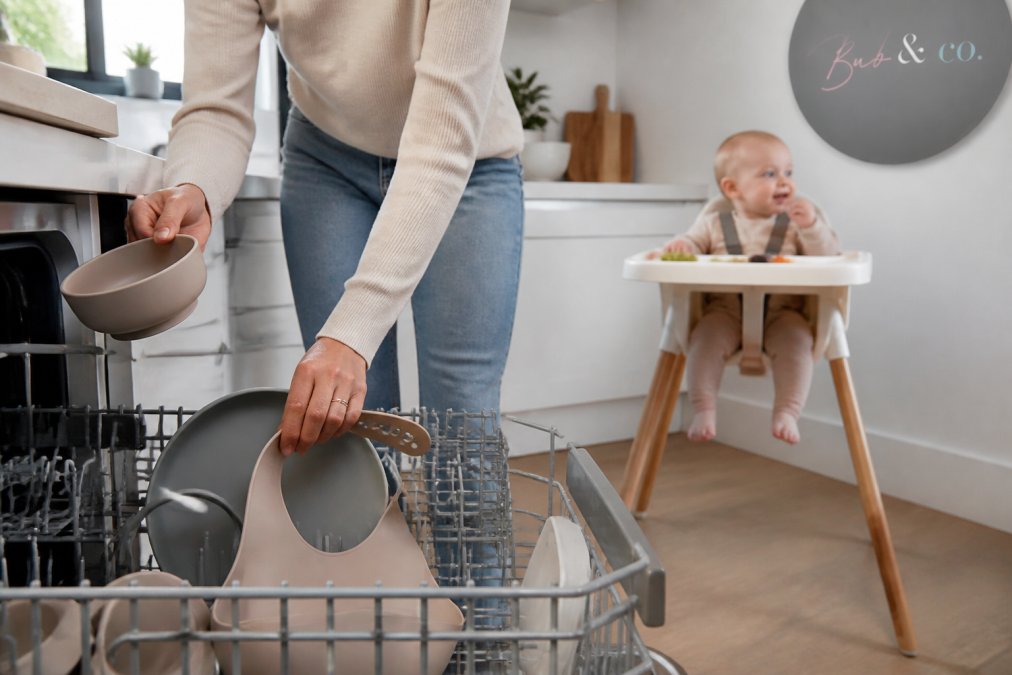
The right gear removes minutes from every single meal, and those minutes compound. A suction bowl that stays put means less food on the floor. A bib with a pocket catches what doesn't make it to the mouth. A plate with deep walls makes scooping easier for small hands still learning hand-eye coordination.
What to Buy First (And What You Can Skip)
| Item | Why It Helps | Priority |
|---|---|---|
| Suction bowl or plate | Stops tipping, less floor cleanup | Buy first |
| Pocket bib | Catches dropped food before the floor | Buy first |
| Silicone placemat | Contains spills, protects the table | Buy first |
| Sippy cup with straw | Supports independent drinking | Buy soon |
| Full coordinated set | Cheaper than buying pieces separately | Best value |
If you'd rather start smaller, the Sun bowl with lid at $20 has a suction base and a snap-on lid for storing leftovers. The Non Grid Suction Plate at $14.95 has deep walls that make scooping easier. The Ultimate Set at $44.95 gives you plate with lid, bowl, bib, spoon and fork in one go.
Choking Hazards in Baby-Led Weaning: What Busy Parents Need to Know
Choking risk is the concern that stops most parents, and it deserves a straight answer. The choking hazards in baby-led weaning come from the shape and texture of food, not from the method itself. Whole grapes, raw hard vegetables, whole nuts, popcorn, and chunks of apple are the usual culprits.
Reduce the risk with safe food preparation:
- Cut grapes and cherry tomatoes lengthways into quarters
- Cook carrot, apple and pear until a fork slides through easily
- Cut finger foods into strips roughly the size of your adult finger
- Always seat your baby upright, never reclined or moving around
- Stay within arm's reach for the whole meal
Gagging vs Choking: Telling the Difference in Seconds
Gagging is loud. Your baby coughs, sputters, goes red in the face, and pushes food forward with the gag reflex. It's a protective mechanism and a normal part of learning to chew.
Meal Prep Strategies That Make Baby-Led Weaning Sustainable
Batch cooking on one day is what separates families who stick with BLW from those who quit. Roast a tray of pumpkin, sweet potato, zucchini and chicken strips on Sunday. Steam a batch of broccoli florets. Store everything in portions your baby can grab.
Baby-Led Weaning in Childcare Settings: What to Arrange Before Daycare
Childcare is where many BLW routines quietly collapse. Most centres have their own feeding schedule and food policies, and they may not be set up for self-feeding babies.
What to sort before your first day:
- Ask whether the centre supports self-feeding or spoon-feeds all babies
- Confirm what food they provide, and whether you can send your own
- Check their choking prevention policy and staff first-aid training
- Send food pre-cut to the size and texture your baby handles
- Pack a labelled bib and suction bowl if the centre allows it
The Downsides of Baby-Led Weaning No One Mentions
The mess is real, and it lasts longer than you expect. Food will end up in hair, on walls, and under the highchair. A silicone placemat and a pocket bib cut it down, but they don't eliminate it.
Frequently Asked Questions
What are the downsides of baby-led weaning for time-poor parents?
The main downsides are mess and prep time. Expect food on the floor, the highchair and sometimes the walls for the first few months, which adds cleaning time to every meal. You also need to plan iron-rich foods and soft finger foods rather than opening a jar. Batch cooking and silicone suction plates with deep walls reduce the load, but the first six weeks are the messiest. Many families find a hybrid approach, with some spoon-feeding alongside self-feeding, keeps the benefits without the daily grind.
Can you combine purees and baby-led weaning?
Yes, and many busy households do. Combining purees and baby led weaning means offering soft finger foods for your baby to pick up while also spoon-feeding purees or mashed meals at other times. This protects self-feeding practice and exposure to textures while keeping mealtimes manageable on work days. The key is to let your baby hold a spoon too, so feeding autonomy still develops. Premade purees can also be spread onto toast fingers or stirred through soft pasta for a quick meal.
Is baby-led weaning actually necessary, or can I just spoon-feed?
It is not necessary. Spoon-feeding with purees is a valid way to introduce solid foods, and many babies thrive on it. Baby-led weaning offers advantages such as self-regulation practice, hand-eye coordination and shared family meals, but you can build those in without following it strictly. If your baby was born prematurely, has feeding difficulties or has developmental concerns, speak with your child health nurse or GP before starting any approach.
How do you manage the mess of baby-led weaning when you are time-poor?
Cut the variables. Use a suction plate or bowl with deep walls so food stays on the tray, add a silicone placemat to contain spills, and choose a bib with a pocket to catch dropped pieces. Lay a washable mat under the highchair and shake it outside after meals. Batch cook soft finger foods once or twice a week and refrigerate portions. Dishwasher-safe silicone pieces also mean you rinse and load rather than scrubbing by hand.
What are the biggest choking hazards in baby-led weaning?
Whole grapes, cherry tomatoes, raw apple or carrot chunks, whole nuts, popcorn, hard lollies and large dollops of nut butter are the usual culprits. Cut grapes and tomatoes lengthways into quarters, cook hard vegetables until soft enough to squash between your fingers, and spread nut butter thinly on toast rather than serving it by the spoon. Always seat your baby upright, supervise every meal and never leave them alone with food, even for a moment.
The challenge with baby-led weaning isn't the method, it's protecting the time it needs. Bub and Co makes that easier with food-grade silicone feeding sets free from BPA, PVC and phthalates, stain-resistant and odour-free pieces that go straight into the dishwasher, and designs that withstand heat and cold without leaching chemicals. Start with the My First Solid Bundle at $60 with free delivery, and let your little one build feeding skills without adding hours to your week.
Leave a comment