
Table of Contents
- Why Move from Purees to Baby Led Weaning
- Signs Baby Is Ready for Finger Foods
- How to Prepare Finger Foods for Babies
- Choking vs Gagging in Infants: What Every Parent Needs to Know
- Baby Led Weaning First Foods List
- Building a Mixed Feeding Schedule That Works
- Equipment and Setup for Safer Self-Feeding
- Conclusion
- Frequently Asked Questions
Last Updated: September 18, 2026
Why Move from Purees to Baby Led Weaning
Baby led weaning is an approach where babies feed themselves whole finger foods from the start of solids, rather than being spoon-fed purees. It builds chewing skills, hand-eye coordination and food confidence early. Many parents now combine it with spoon feeding rather than choosing one method exclusively.
The push away from an all-puree diet usually comes from a practical place.
Raising Children Network guide to introducing solids
Signs Baby Is Ready for Finger Foods
Three signs matter most: sitting upright with minimal support, good head and neck control, and showing real interest in food. Most babies hit all three around six months. Reaching for food and bringing objects to the mouth are strong early indicators too.
Developmental Milestones That Matter
Watch for the palmar grasp giving way to a pincer grasp, which lets a baby pick up smaller pieces between thumb and finger. Loss of the tongue-thrust reflex matters just as much, because a baby who still pushes food out is not ready for lumps.
- Sits unsupported and holds their head steady
- Opens mouth when food approaches
- Brings toys and hands to the mouth deliberately
- Swallows rather than spitting food back out
How to Prepare Finger Foods for Babies
Cut soft foods into strips roughly the length and width of two adult fingers. This gives a baby enough to grip with a fist while a piece still pokes out the top. As the pincer grasp develops, move down to small pea-sized pieces.
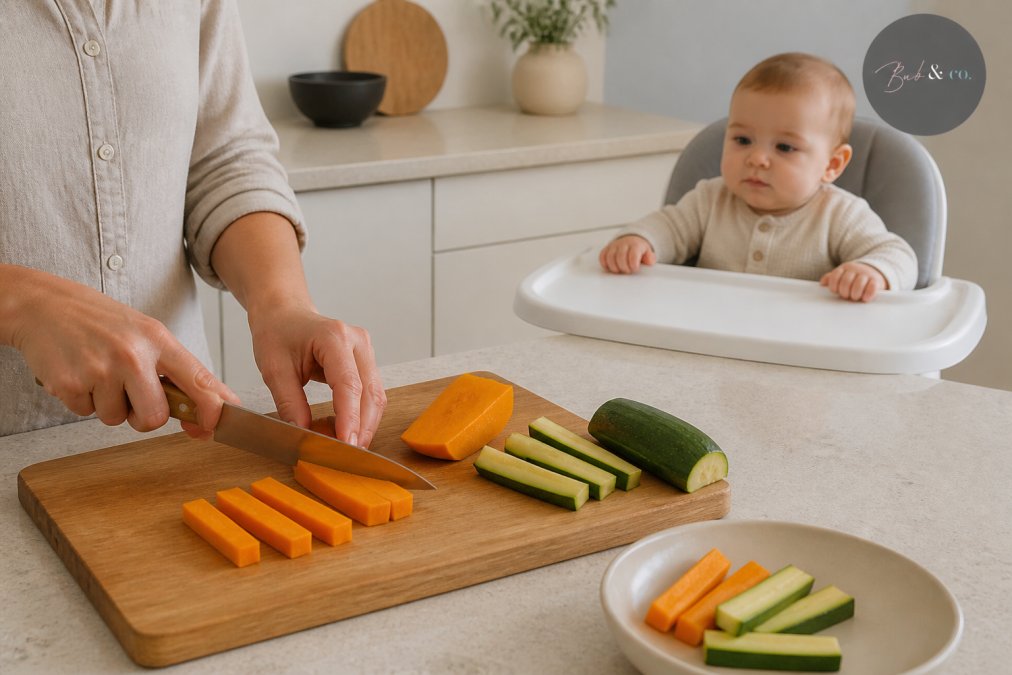
Safe Shapes, Sizes and Textures
Texture progression should move from soft and mashable to firm and lumpy over several weeks. A good test is squashing the food between your thumb and forefinger. If it flattens easily, it is safe.
- Round foods like grapes and cherry tomatoes: quarter lengthways, never serve whole
- Hard raw vegetables: steam or roast until a fork slides through
- Sticky foods like bread: toast it to reduce the gum-clogging risk
- Nut butters: spread thinly on toast rather than serving by the spoon
Choking vs Gagging in Infants: What Every Parent Needs to Know
Gagging is a loud, protective reflex that pushes food forward. Choking is silent, involves a blocked airway and needs immediate action. Gagging is normal and expected during the transition phase. Choking is rare but serious, and knowing the difference keeps parents calm.
Positioning and Setup That Reduce Risk
Most choking incidents during the transition are linked to positioning, not the food itself. A baby must be upright, with feet supported and hips at roughly ninety degrees. A reclined seat, a bouncer or a moving high chair lets food slide toward the airway before the swallow is triggered. Feet should rest flat on a footrest, not dangle, because a stable base steadies the trunk and improves chewing mechanics.
What to Do If Gagging Turns to Choking
If a baby is coughing, let them cough, it is clearing the airway. If the cough becomes silent, if they cannot breathe, cry or make sound, act immediately. Call Triple Zero (000) and start back blows and chest thrusts as taught in a current first aid course. Do not put your fingers into the mouth to sweep for food unless you can clearly see it, because blind sweeps can push the object further down.
Foods and Habits That Raise the Risk
- Whole nuts, popcorn, hard raw apple and large chunks of meat are the most common culprits
- Round foods like grapes and cherry tomatoes must be quartered lengthways, never served whole
- Sticky foods like bread should be toasted to reduce the gum-clogging risk
- Nut butters should be spread thinly on toast, never served by the spoon
- Offering food while a baby is distracted, tired or upset increases the risk regardless of the food
Baby Led Weaning First Foods List
Start with soft, nutrient-dense foods that are easy to grip and rich in iron. Iron stores begin depleting around six months, so this matters more than variety in the first few weeks.
My First Solid Bundle – Baby Silicone →
Nutrient-Rich Options and Foods to Avoid
Good first foods include steamed broccoli florets, roasted sweet potato strips, soft cooked chicken, well-cooked egg, avocado slices and iron-fortified cereal on a loaded spoon.
| First Food | Why It Works | Preparation |
|---|---|---|
| Steamed broccoli | Natural handle, iron and fibre | Steam until stalk is soft |
| Roasted sweet potato | Soft, sweet, easy grip | Cut into finger strips |
| Soft cooked chicken | Iron and protein | Shred or slice thinly |
| Avocado | Healthy fats, soft texture | Thick slices, rolled in oats |
| Well-cooked egg | Iron, choline, easy protein | Scrambled firm or omelette strips |
Building a Mixed Feeding Schedule That Works
A mixed schedule pairs self-feeding with spoon feeding across the day rather than splitting methods by meal. Offer finger foods first, then finish with a spoon-fed iron-rich food such as iron-fortified cereal, mashed lentils or full-fat yoghurt. This keeps intake up while building independence, and it sidesteps the trap of a baby filling up on low-calorie finger foods before the iron source arrives.
A simple pattern for the first month:
- Morning: finger foods plus a spoon-fed iron source
- Midday: finger foods, family meal where possible
- Evening: spoon-fed puree or mash, then a few finger foods
| Day | Morning | Midday | Evening |
|---|---|---|---|
| 1 | Steamed broccoli florets + iron-fortified cereal on a loaded spoon | Roasted sweet potato strips + avocado slices | Pureed pumpkin + soft cooked chicken shreds |
| 2 | Omelette strips + spoon-fed yoghurt | Soft cooked pasta spirals + steamed zucchini | Mashed lentil puree + toast fingers |
| 3 | Toast fingers with thin nut butter + spoon-fed cereal | Steamed carrot sticks + shredded chicken | Pureed kumara + soft pear slices |
| 4 | Scrambled egg + spoon-fed oat porridge | Roasted pumpkin strips + avocado | Mashed chickpea puree + soft cooked broccoli |
| 5 | Soft pear slices + spoon-fed yoghurt | Steamed broccoli + soft meatballs (no added salt) | Pureed silverbeet + toast fingers |
| 6 | Omelette strips + spoon-fed cereal | Soft cooked pasta + steamed zucchini | Mashed potato + shredded chicken |
| 7 | Toast fingers with avocado + spoon-fed yoghurt | Roasted sweet potato + soft cooked egg | Pureed pumpkin + soft pear slices |
The Sensory Side Nobody Warns You About
Most guides focus on mechanics, grip, size, texture, and skip the psychological piece. A baby who has only ever experienced smooth purees can develop texture aversion when lumps arrive, not because the food is unsafe but because the mouth-feel is unfamiliar. The signs are subtle: turning the head, holding food in the mouth without chewing, or spitting out anything with a lump.
Keeping Intake Up When Finger Foods Take Over
Purees are calorie-dense and predictable; finger foods are messy and variable. When a baby starts self-feeding, intake can drop for a week or two before it stabilises. Watch for the signs that matter: at least six wet nappies a day, steady weight gain at your child health checks, and a baby who is alert and settling for naps. If any of those slip, add a spoon-fed iron source back into the meal rather than reducing finger foods.
Equipment and Setup for Safer Self-Feeding
A stable high chair, a footrest at the right height and a suction base under the bowl do more for safety than any gadget. Feet should rest flat, not dangle, because a supported posture reduces choking risk and improves chewing mechanics.
Conclusion
The transition from purees to finger foods asks parents to hand over control at the exact moment they feel least ready to give it. That tension is real, and it fades within a couple of weeks.
Frequently Asked Questions
Can I switch from purees to baby led weaning, and if so, how?
Yes. Start by offering one soft finger food at a meal your baby is already comfortable with, alongside the purees they know. Over two to three weeks, increase the finger food portion and reduce spoon feeding. Watch for signs baby is ready for finger foods, such as sitting upright with minimal support, reaching for food, and bringing items to their mouth. Go at your baby's pace and keep meals relaxed.
Can you do purees and baby led weaning at the same time?
Combining both approaches works well for many families. Offer finger foods first while your baby is alert, then follow with a spoon-fed puree to top up intake. This mixed feeding schedule supports self-feeding skills and fine motor skills like the pincer grasp, while making sure your baby still gets enough energy and nutrients. There is no rule that says you must choose one method only.
How do I prevent choking when introducing solid textures?
Always seat your baby upright in a high chair, supervise every meal, and avoid whole nuts, raw hard vegetables, and round foods like whole grapes. Cut food into finger-length strips or quarter grapes lengthways. Learn the difference between choking vs gagging in infants: gagging is noisy and pushes food forward, while choking is silent and needs immediate action. A paediatric first aid course gives you confidence before you start.
What should be on a baby led weaning first foods list?
Begin with soft, nutrient-rich options: steamed pumpkin or sweet potato strips, ripe avocado wedges, soft cooked broccoli florets, banana, and well-cooked pasta. Add iron-rich foods like shredded slow-cooked meat or mashed lentils. Introduce one new food at a time and wait a few days before the next to spot any reactions. Offer water in an open cup or straw cup with meals to support swallowing reflex development.
Leave a comment