
Table of Contents
- What Baby-Led Weaning Actually Means
- Signs of Readiness for Solids
- Baby-Led Weaning First Foods: What to Offer and When
- How to Prepare Food for Baby-Led Weaning
- Choking vs Gagging in Babies: What Every Parent Must Know
- Setting Up for Success: Equipment, Gear and Mealtime Environment
- Baby-Led Weaning for Busy and Working Parents
- Conclusion
Last Updated: August 16, 2026
What Baby-Led Weaning Actually Means
Baby-led weaning is a feeding approach where infants self-feed soft finger foods from the start of solids, bypassing puréed foods and spoon-feeding entirely. The baby controls what goes into their mouth, how much they eat, and at what pace. Popularised by UK midwife Gill Rapley in the early 2000s, it's now a mainstream feeding method worldwide.
The most common misconception is that baby-led weaning means handing your child a plate and hoping for the best. It means creating a safe, structured mealtime environment where your baby explores food independently, building oral motor skills and feeding autonomy. Infants who self-feed develop a more intuitive relationship with food, learning to recognise hunger and fullness cues without external pressure, linked by paediatric nutrition experts to healthier eating patterns later in childhood. According to Australian Government's Eat For Health infant feeding guidelines, responsive feeding, where a child's hunger and satiety signals are respected, is a key principle of healthy infant nutrition.
Breastmilk or infant formula remains the primary source of nutrition until around 12 months, with solid foods introduced gradually alongside it.
Signs of Readiness for Solids
Most babies show readiness for solid foods between five and seven months, though The Royal Australian and New Zealand College of Obstetricians and Gynaecologists aligns with the World Health Organisation's recommendation of around six months as the appropriate starting point.
Starting too early risks choking; starting too late can affect iron intake and limit the window for allergen introduction.
Developmental Milestones to Look For
Before offering finger foods, your baby should show all of the following signs consistently:
- Sits upright with minimal support and holds their head steady
- Shows interest in food by reaching toward it, watching others eat, or opening their mouth when food approaches
- Has lost the tongue-thrust reflex that automatically pushes foreign objects out of the mouth
- Can bring objects to their mouth with some coordination
- Demonstrates an emerging pincer grasp or palmar grip strong enough to hold food
Sitting upright matters most for safety; a baby who can't maintain an upright position cannot manage solid foods safely.
When to Talk to Your GP or Child Health Nurse
If your baby was born prematurely, has a history of reflux, shows no interest in food by seven months, or has diagnosed feeding difficulties, speak with your GP or child health nurse before starting. Premature babies are assessed using corrected age rather than chronological age. Your Maternal and Child Health nurse is a free resource for any feeding concerns.
Baby-Led Weaning First Foods: What to Offer and When
The best first foods are soft enough to squash between your fingers, large enough for a baby to grip, and nutritionally dense. At six months, a baby's iron stores from birth begin to deplete, making first foods genuinely important.
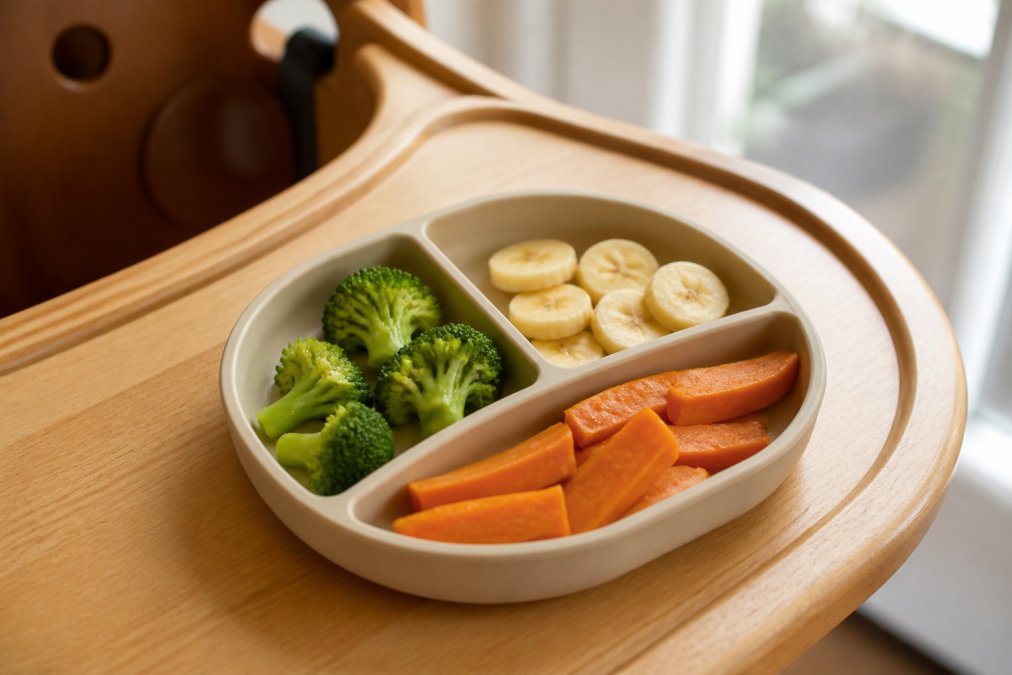
Start with one or two foods per sitting, offered once daily. Portion sizes are small; the goal is exploration, not nutritional intake replacement.
Good starting foods include steamed broccoli florets, soft banana strips, cooked sweet potato spears, ripe avocado slices, soft cooked pear or peach, and scrambled egg.
Iron-Rich Foods to Prioritise
Iron is the nutrient that matters most in the first weeks of baby-led weaning. Breastmilk is low in iron by six months, and infant formula provides some but not always enough once milk volumes drop.
The most bioavailable iron sources for infants are meat and poultry (soft-cooked strips), fish (flaked salmon or white fish), legumes (soft-cooked lentils in a preloaded spoon), and eggs (well-cooked scrambled or hard-boiled). Pairing iron-rich foods with vitamin C sources like soft tomato or steamed capsicum improves iron absorption.
Allergy Introduction Protocols
Introducing common allergens early and deliberately is now evidence-based. ASCIA (Australasian Society of Clinical Immunology and Allergy) infant feeding guidelines recommends introducing the top allergens, egg, peanut, tree nuts, dairy, wheat, soy, sesame, fish, and shellfish, from around six months, once a few non-allergenic foods have been tolerated.
The practical protocol: introduce one new allergen at a time in the morning, wait two to three days before introducing another, and if a reaction occurs (hives, swelling, vomiting, breathing changes), call your GP or 000 immediately. Once tolerated, continue offering that allergen regularly, at least twice a week, to maintain tolerance.
For high-risk infants (family history of food allergy, eczema, or existing allergy), speak with your GP or an allergy specialist before starting allergen introduction at home.
How to Prepare Food for Baby-Led Weaning
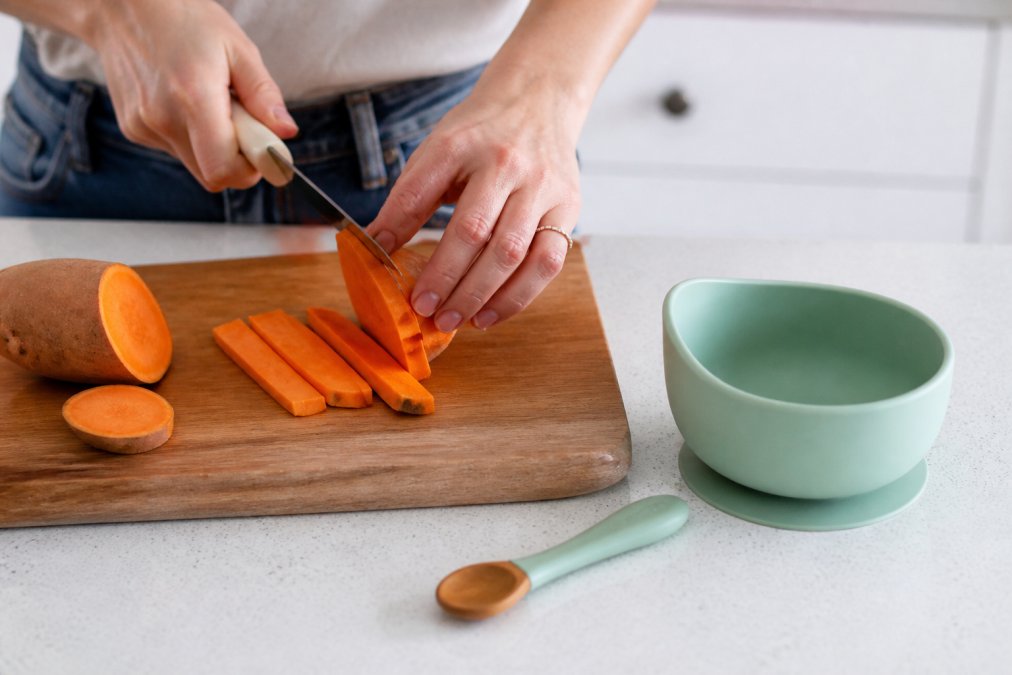
The single most important preparation principle is the "squash test": if you can squash a piece of food between your thumb and index finger with moderate pressure, it's soft enough for a baby.
Sizing, Shape and Texture by Age
Age |
Shape |
Size |
Texture |
|---|---|---|---|
6-7 months |
Long spears or strips |
Length of your finger |
Soft enough to squash easily |
7-9 months |
Shorter pieces, small chunks |
2-3 cm pieces |
Soft but with some resistance |
9-12 months |
Bite-sized pieces, small strips |
1-2 cm |
Soft to firm; varied textures |
12+ months |
Family food textures |
Regular table portions |
Most textures appropriate |
At six months, long spear shapes work best because babies use a whole-hand palmar grip. As the pincer grasp develops, usually between eight and ten months, smaller pieces become manageable.
Avoid round foods that can create a seal in the airway: whole grapes, cherry tomatoes, blueberries, and baby carrots must always be halved or quartered. Hard raw vegetables and whole nuts are not appropriate until three years.
Choking vs Gagging in Babies: What Every Parent Must Know
Understanding the difference between choking and gagging is essential before starting baby-led weaning.
Gagging is a normal, protective reflex. In young babies, the gag reflex is positioned further forward on the tongue, triggering frequently and loudly. A gagging baby will make retching sounds, go red in the face, and may push food forward with their tongue. This is not an emergency; the gag reflex is preventing food from moving too far back before the baby is ready to swallow.
Choking is a genuine emergency. A choking baby will be silent or making high-pitched squeaking sounds, may go pale or blue around the lips, and will show visible distress without the dramatic retching of gagging.
The distinction is stark: gagging is loud, choking is silent.
According to St John Ambulance Australia infant choking first aid guidelines, the correct response to infant choking is five back blows followed by five chest thrusts, repeating until the object is dislodged or emergency services arrive. Every parent starting solids should complete a recognised infant first aid course before introducing any solid foods.
Common choking hazards to avoid: whole grapes, cherry tomatoes, blueberries, raw hard vegetables, whole nuts and seeds, popcorn, hard lollies, and large chunks of meat.
Setting Up for Success: Equipment, Gear and Mealtime Environment
The right setup makes baby-led weaning dramatically easier. A baby sitting at the wrong height, in an unstable chair, or reaching for food on a slippery surface will struggle to self-feed effectively.
The mealtime environment checklist:
- Highchair with footrest: Feet should be flat on a footrest. Hip and knee angles at 90 degrees support core stability and upright sitting posture.
- Adjustable tray height: Food should be within easy reach without the baby leaning forward.
- Suction bowl or mat: Prevents the plate from becoming a projectile.
- Silicone bib with a catch pocket: Reduces floor mess and makes cleanup faster.
- Preloaded spoons: For foods like yoghurt, porridge, and puréed legumes.
Bub and Co's silicone feeding sets are designed for this stage: free from BPA, PVC, and phthalates, stain-resistant, and built to withstand dishwashers and freezers without leaching chemicals. The suction base on bowls stays put on a highchair tray, which makes a noticeable difference when your baby discovers that banging things is fun.
At this age, babies mouth everything. Products containing BPA or phthalates present a real concern when in direct and repeated contact with food and saliva. Non-toxic, microplastic-free silicone is the material standard worth insisting on.
Baby-Led Weaning for Busy and Working Parents
The most common reason parents abandon baby-led weaning isn't safety concerns or a fussy baby, it's time. The fix isn't doing more, it's batching smarter.
The 20-minute Sunday prep system:
- Steam a large batch of vegetables (broccoli, sweet potato, zucchini, carrot) until soft
- Boil or poach two to three chicken thighs and shred into strips
- Hard-boil six eggs
- Portion into airtight containers and refrigerate for up to three days
This gives you a ready-made rotation of iron-rich foods and soft fruits for the week. On busy mornings, breakfast is banana strips and a preloaded spoon of yoghurt. Lunch is reheated vegetable spears and shredded chicken. Dinner is whatever the family is eating, modified to remove salt and cut to appropriate sizes.
Babies who eat at the table with the rest of the family, seeing adults pick up food, chew, and swallow, learn faster and show less mealtime resistance. You don't need to cook a separate baby meal every night.
For parents returning to work, childcare centres can continue baby-led weaning with clear communication. Provide written guidance on the squash test, the shapes your baby is currently managing, and any allergen introduction schedule.
Challenge |
Practical Fix |
Impact |
|---|---|---|
No time for daily prep |
Batch cook on weekends |
Reduces daily prep to 2 minutes |
Messy mealtimes |
Silicone bib with catch pocket + suction bowl |
Less floor cleanup |
Childcare continuation |
Written allergen and texture guide for carers |
Consistency across settings |
Gagging anxiety |
Infant first aid course before starting |
Confidence to continue |
Allergen introduction |
One new allergen per 2-3 days, morning only |
Safe, systematic tolerance building |
Starting baby-led weaning confidently comes down to three things: knowing your baby is ready, understanding the difference between gagging and choking, and having gear that doesn't make the process harder than it needs to be. Bub and Co's silicone feeding sets are built for exactly this stage: non-toxic, stain-resistant, and designed to make self-feeding and cleanup practical rather than stressful. Explore the full range of feeding sets and bundles at Bub and Co, and give your baby the best start with gear that's actually worth buying.
Frequently Asked Questions
How soon can you start baby-led weaning?
Most health guidelines, including those from the Australian Government's Eat for Health program, recommend starting solid foods at around 6 months of age. Starting before 4 months is not recommended. The key is watching for readiness signs rather than going strictly by age: your baby should be able to sit upright with minimal support, hold their head steady, and show interest in food. Breastmilk or infant formula remains the primary nutrition source throughout the early weaning period.
What are the best first foods for baby-led weaning?
Iron-rich foods are the top priority because a baby's iron stores begin to deplete around 6 months. Good first options include soft strips of well-cooked meat, mashed legumes, and iron-fortified cereals offered on a preloaded spoon. Alongside these, soft fruits like ripe banana or avocado and steamed vegetables such as broccoli, carrot, and sweet potato work well. Offer pieces roughly the size of an adult finger so your baby can grip them before their pincer grasp develops.
What is the difference between gagging and choking in babies?
Gagging is a normal, protective reflex. Your baby will look like they are retching, may go red in the face, and will often resolve the food themselves. It is common and actually shows the swallowing reflex is working. Choking is silent and more serious: the airway is partly or fully blocked, the baby cannot cough or cry, and their skin may turn blue. If you suspect choking, act immediately using infant first aid. Learning infant CPR before starting solids is strongly recommended.
What is the 4-day rule for introducing new foods?
The 4-day rule means introducing one new food at a time and waiting four days before adding another. This window gives you time to spot any allergic reaction or intolerance, such as rashes, hives, vomiting, or changes in stool. It is especially useful when introducing the nine common allergens identified by ASCIA (the Australasian Society of Clinical Immunology and Allergy): egg, cow's milk, peanut, tree nuts, wheat, soy, sesame, fish, and shellfish. Early allergen introduction is now recommended, not delayed.
How do I manage the mess during baby-led weaning?
Mess is unavoidable and is actually a sign your baby is exploring food textures and developing oral motor skills. A few practical steps help: use a full-coverage silicone bib with a catch pocket, place a splash mat or old sheet under the highchair, and choose a highchair with a removable, dishwasher-safe tray. Silicone suction bowls and plates reduce tipping. Stripping your baby down to a nappy for meals saves on laundry. Cleaning up immediately after each meal prevents staining and odour build-up on feeding equipment.
What should I focus on in the first month of baby-led weaning?
The first month is about exploration, not nutrition. Breastmilk or infant formula still provides the bulk of your baby's nutritional intake, so there is no need to stress about how much they actually eat. Offer food once a day to start, ideally at a family mealtime so your baby can watch others eat. Focus on soft textures, appropriate portion sizes, and a calm mealtime environment. Introduce iron-rich foods early and begin allergen introduction around this time following ASCIA guidelines.
This article was written using GrandRanker
Leave a comment