
Table of Contents
- What Happens If Baby Eats From Unsafe Dishes
- How Unsafe Dishes Cause Harm: Leaching, Cracks and Bacteria
- Why Babies Are More Vulnerable Than Adults
- Signs of Food Poisoning in Babies
- What to Do Immediately If You Suspect Contamination
- Why Phthalate-Free Baby Spoons and Safe Materials Matter
- How to Clean Silicone Baby Dishes (and Spot Damage Early)
- Choosing Safer Dishes: What to Look For
- Frequently Asked Questions
Last Updated: October 2, 2026
What Happens If Baby Eats From Unsafe Dishes
When a baby eats from a damaged or chemically unsafe dish, the most immediate risks are bacterial contamination from cracks and scratches, and exposure to chemicals that can leach from certain plastics and glazes.
Below, we break down exactly how unsafe dishes cause harm, what symptoms to watch for, and how to choose tableware that holds up to daily use without putting your baby at risk.
How Unsafe Dishes Cause Harm: Leaching, Cracks and Bacteria
Unsafe dishes cause harm through three main pathways: chemical leaching from the material, physical breakdown that traps bacteria, and cumulative toxic exposure over time.
Leaching happens when heat, acidic foods, or age cause a material to release chemicals into food. Tomato puree, citrus, and warm meals are the usual culprits because acid and heat both accelerate the process. The chemicals of concern differ by material:
- Bisphenol A (BPA) and similar bisphenols are used in some polycarbonate plastics and in the linings of certain food containers. They are classed as endocrine-disrupting chemicals, meaning they can interfere with hormone signalling.
- Phthalates are added to soften some plastics. They are also linked to hormone disruption, and concerns centre on chronic exposure rather than a single meal.
- Lead and cadmium can be present in the glaze or decorative paint of some older, imported, or unregulated ceramics. This is a slower, cumulative risk rather than an acute one, and it is the reason heavily decorated or antique crockery is a poor choice for a baby.
- Melamine can migrate into food when melamine tableware is heated or used with acidic foods, which is why it is generally not recommended for microwave or hot acidic meals.
Cracks and scratches create microscopic harbours where pathogens survive washing, especially if the surface is porous.
Cumulative toxic exposure is the pathway parents most often miss. A single meal from a leaching dish is unlikely to cause an acute reaction.
Which dishware materials carry which risk
| Material | Main risk pathway | What to watch for |
|---|---|---|
| Food-grade silicone | Very low leaching; non-porous | Replace if torn or persistently odorous |
| Polypropylene (BPA-free plastic) | Low leaching when intact; scratches trap bacteria | Retire once visibly scratched or cloudy |
| Polycarbonate plastic | BPA leaching, especially with heat | Avoid for hot food and repeated use |
| Melamine | Migration when heated or with acidic food | Not for microwave or hot acidic meals |
| Glazed ceramic | Lead/cadmium if glaze is unregulated or damaged | Avoid chipped glaze and unknown imports |
| Stainless steel | Very low risk | Check for rough welds or sharp edges |
A dish that is intact and made from a known-safe material is doing its job. The problems start when heat, acid, or physical damage give a material a way to release something into food.
Why Babies Are More Vulnerable Than Adults
Babies face higher risk from unsafe dishes because of three factors working together: an immature immune system, a smaller body mass, and hand-to-mouth behaviour.
Their gastrointestinal tracts are still building the defences that adults take for granted. That means bacterial contamination that would cause mild discomfort in an adult can trigger more serious gastrointestinal distress in an infant.
This is why paediatric guidance leans conservative on feeding materials. When in doubt, choose the safer material.
Signs of Food Poisoning in Babies
The signs of food poisoning in babies typically appear within hours to a few days of eating contaminated food, and the most common are vomiting, diarrhoea, and abdominal cramping.
Key symptoms to monitor:
- Nausea and repeated vomiting
- Watery or bloody diarrhoea
- Abdominal cramping and general irritability
- Fever
- Refusing feeds or showing low energy
- Fewer wet nappies than usual
Dehydration is the complication that worries clinicians most in infants. A baby who is vomiting and having diarrhoea can lose fluid quickly. Watch for a dry mouth, sunken eyes, crying without tears, and unusual sleepiness.
When to Seek Medical Attention
Seek medical attention immediately if your baby shows any of the following: blood in the stool or vomit, signs of dehydration, a fever in a baby under three months, persistent vomiting, or unusual lethargy.
For milder symptoms, a paediatric consultation is still wise if things haven't improved within 24 hours. Trust your instincts: if your baby seems significantly unwell, get them seen.
What to Do Immediately If You Suspect Contamination
If you suspect your baby has eaten from a contaminated dish or ingested spoiled food, stop the feeding, keep your baby hydrated, and call your doctor or a health advice line for guidance.
The harder question is how to tell a harmless exposure from one that needs urgent care. Use the triage below, and when in doubt, err toward seeking advice.
Step 1: Identify what was actually ingested
Before you do anything else, work out which of these three situations you are dealing with, because each has a different response:
- Food that may have been contaminated by a cracked or poorly cleaned dish. This is a foodborne-illness risk. Monitor for gastrointestinal symptoms.
- A chemical leached from the dish material (for example, a hot acidic meal in an old plastic container). A single exposure is usually low risk, but note the material and the food.
- A physical fragment such as a chip of glaze, ceramic, or plastic. This is a choking and internal-injury risk, not a poisoning risk, and it needs a different response.
Step 2: Match the response to the situation
| Situation | Immediate action |
|---|---|
| Suspected food contamination, baby well | Remove the dish, offer fluids, monitor for 24-48 hours |
| Suspected chemical leaching, baby well | Remove the dish, note the material, call a health advice line for guidance |
| Suspected swallowed fragment | Do not induce vomiting; seek same-day medical assessment |
| Any severe symptom (see Step 3) | Call emergency services or go to the nearest emergency department |
Step 3: Know the red flags that mean emergency care
Go straight to emergency care, or call emergency services, if your baby has any of the following:
- Difficulty breathing, choking, or noisy breathing
- A swollen, tender, or rigid abdomen
- Blood in vomit or stool
- Signs of severe dehydration: no wet nappies for several hours, a sunken soft spot, crying without tears, or unusual floppiness
- A fever in a baby under three months
- Persistent vomiting that prevents any fluid being kept down
- Unusual lethargy, unresponsiveness, or a seizure
Step 4: Gather the right information for the clinician
When you call for advice or arrive at a clinic, having these details ready speeds up assessment:
- What your baby ate, and roughly how much
- The time of the feed
- The dish material and its condition (cracked, scratched, chipped, or intact)
- Whether the food was heated, and whether it was acidic
- Any symptoms, and when they started
- Your baby's age and any relevant medical history
Step 5: Monitor at home only if all of these are true
Home monitoring is reasonable only when your baby is over six months, has no underlying condition, is feeding and drinking normally, has no red-flag symptoms, and is producing normal wet nappies. If any of those is not true, seek care rather than waiting.
If your baby is under six months, has a compromised immune system, or shows any severe symptom, skip the wait-and-see step and seek care straight away. Early symptom monitoring makes a real difference in how quickly an infant recovers.
Why Phthalate-Free Baby Spoons and Safe Materials Matter
Phthalate-free baby spoons matter because phthalates are a class of chemicals used to soften some plastics, and they are linked to concerns around hormone disruption and developmental delays with chronic exposure. Choosing food-grade silicone avoids that category of risk entirely.
Silicone is inert, heat-resistant, and doesn't leach when exposed to hot or cold food. That's the core reason Bub and Co builds its feeding range from food-grade silicone that is free from BPA, PVC and phthalates.
Material comparison at a glance:
| Material | Leaching Risk | Breakage Risk | Best For |
|---|---|---|---|
| Food-grade silicone | Low | Low | Everyday feeding, heat and cold |
| Plastic (non-BPA-free) | Higher | Moderate | Not recommended for babies |
| Ceramic (glazed) | Depends on glaze | High | Older children, supervised use |
| Melamine | Moderate | Low | Occasional use only |
The practical takeaway: for a dish that's going in the microwave, the dishwasher, and your baby's mouth every day, silicone is the material that holds up without the chemical question marks.
How to Clean Silicone Baby Dishes (and Spot Damage Early)
Knowing how to clean silicone baby dishes properly is what keeps them safe for the long run. Wash with warm soapy water or on the top rack of the dishwasher, and inspect the surface for damage at the same time.
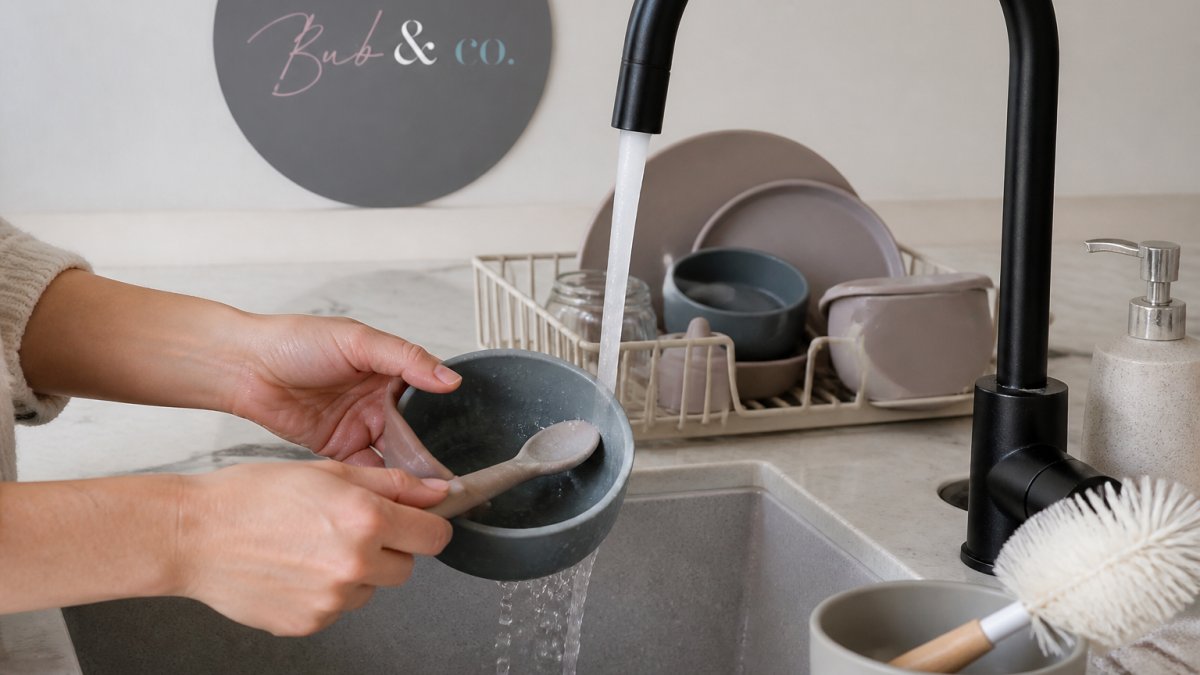
A workable routine:
- Rinse immediately after meals to stop stains and odours setting in.
- Wash in warm, soapy water, or use the dishwasher (top rack recommended).
- Avoid abrasive scrubbers that scratch the surface.
- Check for cracks, cloudiness, or a lingering smell after washing.
- Replace any piece showing damage or a persistent odour.
Silicone is naturally stain-resistant, but strongly coloured foods like tomato or curry benefit from a quick rinse. If a dish still smells after a proper wash, that's your signal to retire it.
Choosing Safer Dishes: What to Look For
The safest dishes for babies are made from food-grade silicone, carry no BPA, PVC or phthalates, and hold up to heat without leaching. That combination covers the three main risk pathways at once.
What to check before you buy:
- Material stated clearly as food-grade silicone
- Free from BPA, PVC and phthalates
- Microwave and dishwasher safe
- No cracks, chips, or rough edges on arrival
- Suction bases that grip a highchair tray properly
For a starter kit, the Mini Bub Set ($25.00) covers a bib, bowl and spoon, with a suction bowl that stays put on a clean, flat surface. If you want the full mealtime setup, the Ultimate Set ($44.95) adds a plate with lid, fork and more. Families feeding siblings often opt for the Pagi Kids Feeding Set ($39.95), which comes in ten colours and includes a leakproof sippy cup.


Frequently Asked Questions
What happens if a baby eats from a dish with scratches or cracks?
Scratches and cracks create tiny grooves where bacteria can collect, even after washing. If the dish is plastic, damaged surfaces can also shed small particles into food. Check dishes regularly and replace any that are cracked, cloudy or rough to the touch. Silicone dishes that stay smooth and intact are easier to clean properly and less likely to harbour pathogens.
How long does food poisoning last in babies?
Most cases of foodborne illness in babies settle within a few days, but symptoms like vomiting, diarrhoea and abdominal cramping can lead to dehydration faster than in adults. Watch for fewer wet nappies, a dry mouth, sunken eyes or unusual drowsiness. If your baby is under 6 months, has blood in their stool, or cannot keep fluids down, seek medical attention promptly.
Are BPA-free labels enough to guarantee baby dish safety?
No. A BPA-free label only confirms that one chemical was not used. Some plastics still contain other additives, and older or damaged dishes can leach substances when heated. Look for food-grade silicone that is free from BPA, PVC and phthalates, and check that the product is designed for microwave and dishwasher use without breaking down.
How do I know if my baby's silicone dishes are food-grade?
Food-grade silicone is usually labelled as such and states it is free from BPA, PVC and phthalates. It should feel smooth, have no plastic odour, and stay flexible without cracking after repeated washing. If a product has no material information, a strong chemical smell, or becomes sticky or discoloured quickly, it is worth replacing with a clearly labelled alternative.
Mealtime safety comes down to the dish as much as the food, and that's a detail most parents only think about after something goes wrong. Bub and Co makes that decision easier with food-grade silicone feeding sets that are free from BPA, PVC and phthalates, stain-resistant, and built to handle heat and cold without leaching. If you're ready to replace worn or questionable tableware, shop the Bub and Co feeding sets and give your little one a safer surface to eat from every day.
Leave a comment