
Table of Contents
- How to Create a Baby Food Schedule for 6 Months: A Step-by-Step Plan
- What a 6 Month Baby-Led Weaning Schedule Looks Like
- How Often to Feed Solids to a 6 Month Old
- Balancing a Breast Milk and Solids Schedule at 6 Months
- Baby-Led Weaning First Foods and Safe Preparation
- Common Mistakes to Avoid When Starting Solids
- Conclusion
- Frequently Asked Questions
Last Updated: October 7, 2026
How to Create a Baby Food Schedule for 6 Months: A Step-by-Step Plan
Starting solids is one of the biggest milestones in your baby's first year. A baby food schedule at 6 months is simply a plan for when milk feeds and solid meals happen each day, built around your baby's readiness and hunger cues rather than a clock.
The short answer: there is no single "correct" schedule. What matters is that milk stays the main source of nutrition, solids are offered once or twice a day at first, and you follow your baby's cues.
Step 1: Check Developmental Readiness Signs
Readiness matters more than the date on the calendar. Most babies are ready at around six months, but the signs below are a better guide than age.
Look for these signs together:
- Sits upright with little or no support
- Holds their head steady and controls neck muscles
- Reaches for food and brings objects to their mouth
The tongue-thrust reflex, where a baby pushes food out, usually fades around this age. If it's still strong, your baby may need more time.
If your baby was born prematurely, use their corrected age rather than their birth age when judging readiness.
Step 2: Choose Your Start Date and First Meal Time
Pick a time when your baby is alert and not ravenous. Mid-morning works well: it's after the first nap, your baby is calm, and any reaction to a new food can be watched all day.
Start with one meal a day for the first week or two, offered after a milk feed so your baby isn't too hungry to be patient with a new skill.
A simple first-week pattern:
- Milk feed as usual
- Wait 30 to 60 minutes
- Offer solids for 10 to 15 minutes
That's it. One meal, once a day, for the first week.
Step 3: Build the Week Around Milk Feeds
Milk feeds come first. At 6 months, most babies still feed on demand, roughly four to six milk feeds a day.
By the end of the first month of solids, you can move to two meals a day. By around nine months, most babies are on three meals plus milk.
Here's how the first month typically unfolds:
| Week | Meals per day | Milk feeds | Focus |
|---|---|---|---|
| Week 1 | 1 | Unchanged | Tasting and exploring |
| Week 2 | 1 to 2 | Unchanged | Adding variety |
| Week 3 | 2 | Unchanged | Building a routine |
| Week 4 | 2 to 3 | Slight drop | Sitting at family meals |
Don't cut milk feeds to "make room" for solids. Milk intake should stay steady through this early stage.
What a 6 Month Baby-Led Weaning Schedule Looks Like
A 6 month baby-led weaning schedule offers soft finger foods at mealtimes and lets your baby feed themselves from the start. There's no spoon-feeding purees first. The structure of the day barely changes from a spoon-feeding schedule; what changes is how the food is served and who controls the pace.
A Sample Day at 6 Months
Every baby is different, but this is a realistic shape for the day:
- 7:00am - Wake and milk feed
- 8:30am - Breakfast: soft finger foods on the highchair tray
- 10:00am - Nap
Milk still anchors the day; solids are short, low-pressure sessions tucked between naps and feeds.
How Often to Feed Solids to a 6 Month Old
Offer solids once or twice a day when you first start. More than that overwhelms most babies in the first few weeks. But frequency is only half the question, the other half is how you know your baby is moving forward.
Three stages of learning to eat
It helps to separate "eating" into three stages:
- Early exploration (roughly the first 2 to 4 weeks). Your baby mouths food, squashes it, drops it, and may swallow very little. This is not failure. It is how they map texture, taste and the mechanics of moving food around the mouth.
- Reliable self-feeding (often around 7 to 9 months). Your baby picks up soft finger foods, brings them to the mouth with reasonable accuracy, and manages a wider range of textures. More food starts going in than coming out.
- Eating substantial amounts (usually from around 9 to 12 months). Solids begin to replace some of the nutrition milk was providing. Meals get longer and more food is actually swallowed.
The first stage usually takes the longest and feels the slowest. Many parents worry at week three that nothing is being eaten, but the skill is being built even when the volume is tiny.
Signs of progress to watch for
Rather than counting bites, watch for these markers, which show your baby is advancing even when the plate still looks full:
- Bringing food to the mouth rather than only batting it around
- Keeping food in the mouth for a few seconds before it comes back out
- Managing a lumpier or slightly firmer texture that would have been rejected a fortnight ago
If you're seeing these, your baby is progressing. If you're not seeing any after six to eight weeks of regular practice, check in with your child health nurse or GP.
What to do when progress seems slow
Slow progress is common and usually resolves. A few things worth trying before you worry:
My first solid bundle - FREE Shipping →
- Limited interest. Offer solids when your baby is alert but not starving. A baby who is too hungry wants milk, not a lesson.
- Food throwing. This is usually exploration, not rejection. Keep meals short, offer one or two pieces at a time, and don't react dramatically.
- Gagging that worries you. Gagging is loud and forward. It usually reduces as texture skills build. If it happens with every meal and never improves, seek advice.
Watch for hunger cues and fullness cues rather than counting bites:
- Hunger cues: leaning forward, opening the mouth, reaching for food
- Fullness cues: turning the head away, closing the mouth, pushing food away, arching the back
Responsive feeding means you follow those cues. Don't coax an extra spoonful in. Don't worry if some days your baby eats almost nothing.
By around eight to nine months, most babies move to three meals a day. By twelve months, three meals plus snacks is typical. The pace varies, and that's normal.
Balancing a Breast Milk and Solids Schedule at 6 Months
Milk still does the heavy lifting at this age. A breast milk and solids schedule at 6 months keeps milk feeds steady while solids build slowly underneath.
A few practical rules:
- Offer milk before solids at first, so your baby isn't too hungry to focus
- Keep the same number of milk feeds for the first month
- Let solids grow in volume, not in frequency, before you add a meal
If you're expressing or using formula, the same logic applies. Don't drop a bottle to add a meal at this stage.
Baby-Led Weaning First Foods and Safe Preparation
Baby-led weaning first foods should be soft enough to squash between your fingers. If you can't squash it, your baby can't manage it safely.
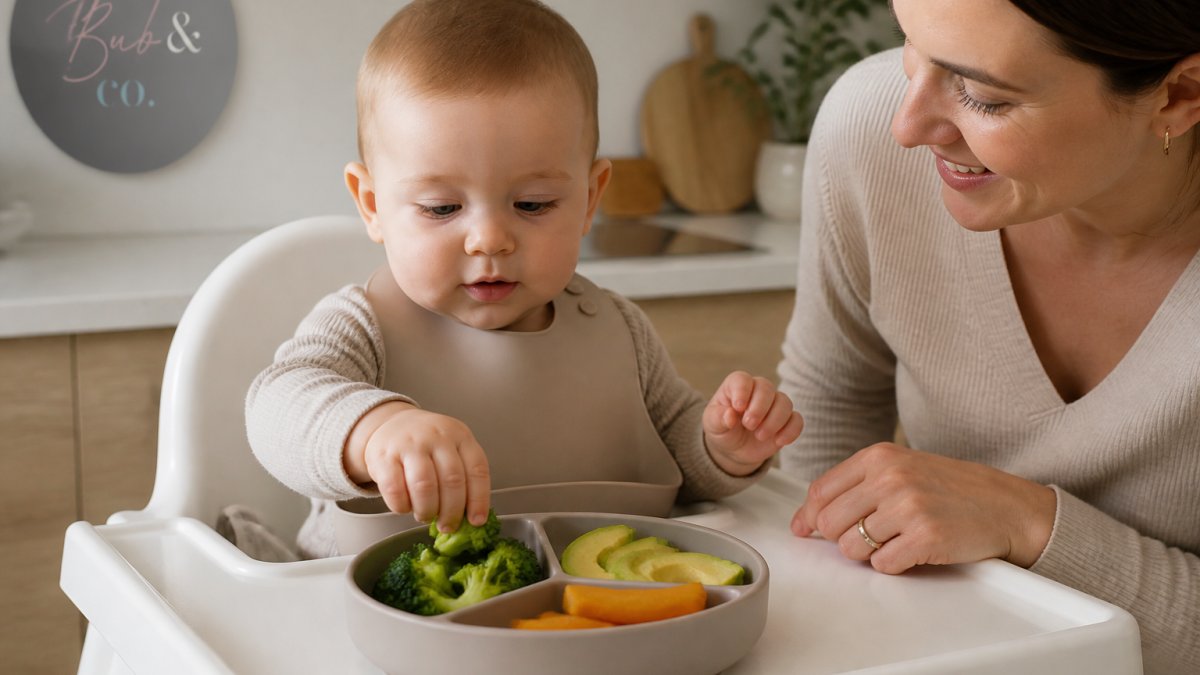
Good first foods to try:
- Steamed broccoli and cauliflower florets, with the stalk as a handle
- Soft avocado slices
- Cooked pumpkin or sweet potato sticks
- Soft cooked pasta shapes
Safe shapes matter as much as the food itself. Cut finger foods into sticks about the size of your adult finger, so your baby can grip one end and chew the other.
Serving food on a plate that stays put makes a real difference here.
Common Mistakes to Avoid When Starting Solids
Most early problems come from moving too fast. The mistakes we see most often:
- Rushing the number of meals. One meal a day is plenty for the first week or two.
- Cutting milk too soon. Milk is still the main nutrition source until around twelve months.
- Serving food that's too hard. If you can't squash it, don't serve it.
- Leaving baby unsupervised. Always stay within arm's reach during meals.
Gagging is a protective reflex that moves food forward in the mouth. It's common early on and usually settles as your baby learns textures. Choking is different: your baby will be silent, unable to breathe or cough. Learn infant first aid before you start solids.
When to get professional advice
Most feeding wobbles settle on their own. But some signs warrant a conversation with your GP, child health nurse or a paediatric feeding professional:
- Persistent gagging at every meal that isn't improving after several weeks
- Coughing, spluttering or wet-sounding breathing during or after meals
- Food or liquid coming back through the nose
- Refusing all solids for more than a couple of weeks, or distress at mealtimes
If your baby was born prematurely, has a developmental or medical condition, or has had feeding difficulties from birth, raise solids with their care team before you start rather than waiting for a problem to appear.
A note on individual variation
There is no single deadline for mastering self-feeding. Motor development, prior feeding experience, temperament, and any medical or developmental needs all affect the pace.
The goal at six months is not a clean plate but a calm, supervised, low-pressure chance to practise. Keep milk steady, offer food regularly, and follow your baby's cues, and you are doing the work that matters.
Conclusion
Building a baby food schedule at 6 months comes down to three things: checking readiness, starting with one meal a day, and keeping milk feeds steady while solids grow underneath. Progress is uneven, and that's expected.
The tools you use at the table make the daily routine easier. Bub and Co's feeding sets are made from food-grade silicone that's free from BPA, PVC and phthalates, with suction bases that grip the highchair tray and dishwasher-safe pieces for quick clean-up.

Get started with Bub and Co and make mealtimes simpler while your little one learns to eat.
Frequently Asked Questions
How many times a day should a 6-month-old eat solids?
Start with one meal per day, ideally when your baby is alert and not overly hungry. After a week or two, add a second meal. By around 8 to 9 months, most babies move to three meals. Milk remains the main source of nutrition at 6 months, so solids are about practice and exploration rather than filling them up.
Should I offer breast milk or formula before or after solids?
Offer milk first at 6 months, then solids about 30 to 60 minutes later. This keeps your baby's primary nutrition on track while they learn to eat. As solid intake increases around 9 to 12 months, you can shift solids earlier and milk later. Watch your baby's cues rather than watching the clock.
What does a sample 6-month baby-led weaning schedule look like?
A typical day might include a milk feed on waking, breakfast of soft finger foods an hour later, a mid-morning milk feed, a nap, lunch, another milk feed, dinner, and a final milk feed before bed. Adjust around naps and appetite. The goal is one or two solid meals fitted around your existing milk routine, not a rigid timetable.
How do I know if my baby is ready to start solids?
Look for three signs together: your baby can sit upright with minimal support, holds their head steady, and has lost the tongue-thrust reflex so food stays in the mouth rather than being pushed out. Reaching for food and bringing objects to the mouth are also good indicators. Most babies show these signs around six months.
Leave a comment