
Table of Contents
- Quick Comparison: Non Toxic Baby Feeding Sets at a Glance
- How We Chose These Non Toxic Baby Feeding Sets
- My First Solid Bundle: Best All-In-One Starter Kit
- Pagi Kids Feeding Set: Best Value Four-Piece Set
- Ultimate Set and Junior Set: Best for Toddlers Moving to Independent Eating
- Mini Bub Set and Breakfast, Lunch & Dinner Bundle: Best for Small Budgets and Full-Day Rotation
- The Benefits of Baby Led Weaning Sets for Self-Feeding
- How to Clean Silicone Baby Feeding Sets Without Damaging Them
- Frequently Asked Questions
Last Updated: September 16, 2026
Quick Comparison: Non Toxic Baby Feeding Sets at a Glance
This guide from Bub and Co covers what each bundle includes, who it suits, and the cleaning rules that keep silicone in good condition. Options start at $25 and run to $79.
| Set | Price | Pieces | Best For |
|---|---|---|---|
| My First Solid Bundle | $60.00 | 8+ across four products | First solids, all-in-one |
| Pagi Kids Feeding Set | $39.95 | 4 | Best value starter set |
| Ultimate Set | $44.95 | 6 | Toddlers eating independently |
| Junior Set | $44.95 | 4 | Confident self-feeders |
| Mini Bub Set | $25.00 | 3 | Small budgets, first foods |
| Breakfast, Lunch & Dinner Bundle | $79.00 | 3 full sets + plate | Full-day rotation |
How We Chose These Non Toxic Baby Feeding Sets
A common mistake is buying a set for its suction base, then finding the bib is polyester and the spoon polypropylene. Every set below keeps food-contact pieces in silicone, except the wooden spoon handle in the Mini Bub Set, which is why that spoon is hand wash only.

My First Solid Bundle: Best All-In-One Starter Kit
Bub and Co's My First Solid Bundle is our top pick for a baby's first weeks on solids. At $60 with free Australia-wide shipping, it bundles a Pagi Kids Feeding Set, a Non-Grid Suction Plate, a Silicone Placemat and a Sip-N-Snack Cup, $84.80 bought separately, saving $24.80.

Pagi Kids Feeding Set: Best Value Four-Piece Set
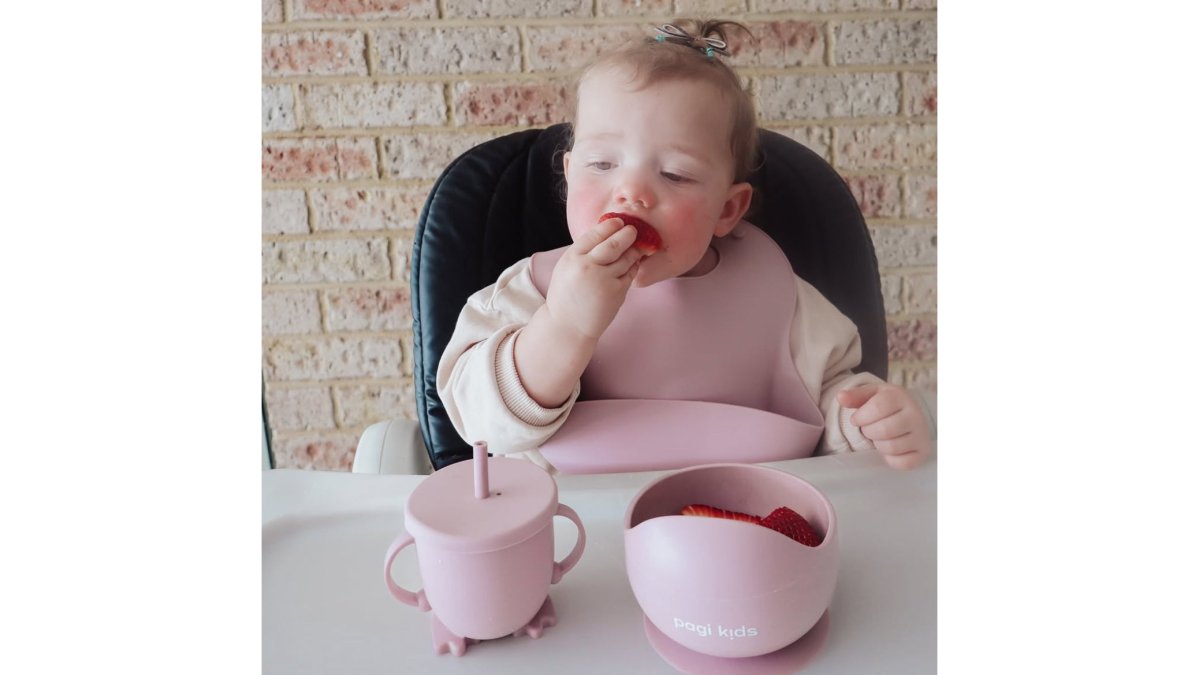
For parents who want the essentials without extras, the Pagi Kids Feeding Set at $39.95 is the strongest value in the range: a pocket bib with reinforced eyelets that fits babies from six months, a curved suction bowl, an ergonomic spoon, and a leakproof sippy cup with a detachable lid and internal straw.
Ultimate Set and Junior Set: Best for Toddlers Moving to Independent Eating
Toddlers need different geometry from babies. The Ultimate Set and Junior Set, both $44.95, are built for that transition. The Ultimate Set is a six-piece kit: plate with lid, suction bowl, bib, spoon and fork. The Junior Set is a four-piece version with suction plate, suction bowl, cup and spoon.

Mini Bub Set and Breakfast, Lunch & Dinner Bundle: Best for Small Budgets and Full-Day Rotation
Two options cover the extremes of budget and volume. The Mini Bub Set at $25.00 includes a bib, a suction bowl and a spoon, the cheapest way to test whether silicone works for your baby before committing to a larger set. The bowl is microwave and dishwasher proof, though the spoon has a wooden handle and should be hand washed.
The Benefits of Baby Led Weaning Sets for Self-Feeding
Baby led weaning sets are designed around a simple idea: babies learn to eat by handling food themselves, so the gear should get out of the way. That means suction bases that hold a bowl steady, short-handled spoons sized for a fist grip, and sectioned plates that keep textures separate. What most guides skip is why silicone supports this, and how the gear should change as a baby's grip, jaw strength and sensory tolerance develop.
Why silicone suits self-feeding better than rigid tableware
Silicone is soft on gums, hypoallergenic and non-porous, so it does not harbour the residue that makes rigid tableware smell over time. It also flexes under pressure: when a baby bites a silicone spoon, it gives slightly rather than pressing back against the gum, and that feedback loop is part of how babies learn to modulate bite force. A rigid metal or hard-plastic spoon gives no such feedback, and some babies respond by clamping down harder.
How the gear should change with the stage
The benefits show up in stages: the set that works at six months rarely works at eighteen.
- Around six months (first tastes): a shallow suction bowl and a soft-tipped spoon. Depth matters, a deep bowl makes it hard for a baby to see and reach the food, so shallow, wide bowls work better than tall ones.
- Eight to ten months (the scooping phase): an ergonomic spoon with a short, thick handle sized for a whole-fist grip. A long handle forces a baby to hold it like an adult, so the spoon ends up sideways and the food falls off.
- Twelve months plus (independent eating): a fork with rounded tines, a lidded plate for storage, and a cup with a straw or free-flow spout. The fork is the piece that changes mealtimes, once a toddler can stab a piece of steamed carrot, self-feeding stops being a spectator sport.
The sensory angle most guides ignore
For neurodivergent babies and those with sensory processing sensitivities, the material of the feeding gear is often the deciding factor in whether a meal is calm or distressing. A few patterns are worth knowing:
My First Solid Bundle – Baby Silicone →
- Texture sensitivity: some babies reject metal spoons because the cold, hard surface is jarring against the lips. A soft silicone spoon removes that barrier without changing the food.
- Sound sensitivity: metal cutlery scraping a ceramic or melamine plate is a common trigger. Silicone-on-silicone is almost silent, which can make a measurable difference to a baby who startles at mealtimes.
- Tactile defensiveness: a baby who will not touch wet or sticky food may still accept it from a silicone spoon they can hold themselves, because the spoon acts as a barrier between hand and food.
- Colour and predictability: offering the same colour bowl at every meal reduces novelty load. Sets that let you keep one colour consistent across plate, bowl and cup are more useful here than mixed-colour bundles.
The trade-offs to weigh
If your baby has a sensitive gag reflex, a shallow bowl and a soft spoon help them manage portions, though gagging is a normal developmental stage most babies work through regardless of the gear.
How to Clean Silicone Baby Feeding Sets Without Damaging Them
Cleaning silicone baby feeding sets is straightforward. Most guides stop short here: they say "dishwasher safe" without explaining what repeated high-heat cycles do to food-grade silicone.
What heat does to silicone over time
Food-grade silicone is a cross-linked polymer, stable across a wide temperature range, typically rated from about -40°C to 230°C for oven-safe pieces. That does not make it inert under repeated thermal cycling. Silicone exposed to the top rack of a dishwasher on a hot cycle (often 65-70°C during the wash and higher during drying) hundreds of times will gradually lose surface integrity, showing up as a dull, chalky finish, a faint lingering smell even after washing, and suction bases that no longer grip as firmly.
A cleaning routine that protects the material
- Rinse within an hour of the meal, strongly coloured foods like tomato, turmeric, curry and beetroot are the main cause of staining, and the pigment sets faster on a warm surface
- Wash with warm soapy water and a soft sponge for everyday meals
- Use the dishwasher top rack only, and choose a lower-temperature or eco cycle where your machine offers one
- Skip the heated drying cycle if your dishwasher has a separate setting, air drying is gentler on silicone
- Avoid abrasive scrubbers, steel wool and powdered cleansers, which scratch the surface and create places for residue to sit
- Hand wash any wooden-handled pieces and keep them out of the microwave entirely
- Check suction bases for trapped food before the next meal, a grain of rice under the rim defeats the seal
- Air dry fully before stacking, because trapped moisture between stacked plates is what causes that sour smell
Deep cleaning without damaging the surface
For stubborn stains or smells, a bicarbonate-of-soda paste (roughly three parts bicarbonate to one part water) applied for ten minutes and rinsed with warm water lifts most discolouration without abrasion. A diluted white vinegar soak, one part vinegar to four parts water for fifteen minutes, neutralises odours. Do not boil silicone to sterilise it; boiling is fine for a first-use clean, but repeated boiling accelerates the same surface degradation as a hot dishwasher cycle.
Getting suction to actually work
Suction is a mechanical seal, not a chemical one, and it fails for predictable reasons. Press down firmly in the centre of the base on a clean, dry, flat surface. Textured highchair trays, common on wooden highchairs and many travel seats, defeat suction no matter how good the base is; a silicone placemat underneath gives the base something smooth to grip.
Frequently Asked Questions
Are silicone baby feeding sets truly non-toxic?
Food-grade silicone is made from silica, which is found in sand, and does not contain BPA, PVC or phthalates. It stays stable across a wide temperature range, so it does not release toxic fumes during normal use or when heated. Look for sets that state these exclusions clearly and confirm they are dishwasher and microwave safe. Silicone is also non-porous, so it resists stains and odours better than many plastics.
What materials should I avoid in baby feeding sets?
Avoid anything made from PVC, which often contains phthalates used to soften plastic. Skip products where the listing does not confirm the material is BPA-free and phthalate-free, and be wary of cheap plastics that carry no material information at all. Lead and cadmium can appear in low-cost painted or decorated tableware, so stick to unpainted silicone, stainless steel or glass. If a product does not name its material, treat that as a reason to keep looking.
How do I clean and sanitise silicone baby feeding sets?
Rinse pieces straight after meals to stop strongly coloured foods like tomato or curry from setting in. Most silicone is dishwasher safe on the top rack, and warm soapy water works for hand washing. Avoid abrasive scrubbers, which can dull the surface. Always check the care instructions on the product page, especially for items with wooden handles, which should be hand washed only.
Are suction plates and bowls effective for baby-led weaning?
They help, but they are not magic. Suction bases hold best on clean, dry, smooth and non-textured surfaces, so press down firmly in the centre of the base to push out trapped air. Textured highchair trays and uneven tables reduce how well the suction grips. Combined with easy-grip spoons and a curved bowl design, suction tableware gives babies a steadier target while they practise self-feeding, which cuts down on tipped bowls and thrown food.
Is it worth switching to silicone if my baby already uses plastic spoons?
It depends on what you are trying to fix. Silicone is softer on gums, which helps babies with a sensitive gag reflex or those still teething. It is also non-porous, so it resists the staining and lingering smells that plague cheaper plastics over time. If your current spoons are scratched, discoloured or smell after washing, that is a good sign it is time to replace them. Switching one spoon at a time is a reasonable middle ground.
Leave a comment