
Table of Contents
- What to Look for in Silicone Feeding Sets for Toddlers
- Why Food-Grade Silicone Beats Plastic for Non-Toxic Toddler Dinnerware
- The Benefits of Silicone Feeding Sets for Self-Feeding and BLW
- 1. Ultimate Set: The Complete 6-Piece Kit
- 2. Junior Set: A Cup-Complete Option for Growing Toddlers
- 3. Pagi Kids Feeding Set: Value-Packed Starter
- 4. Mini Bub Set: Compact and Budget-Friendly Trio
- How to Clean Silicone Baby Plates: Stains, Odours and Care
- Frequently Asked Questions
Last Updated: September 7, 2026
Choosing the right silicone feeding sets for toddlers can feel overwhelming, especially when every brand promises the safest, most durable option. The reality is that not all silicone is created equal, and the difference between a set that lasts through two children and one that stains after a month comes down to material quality and design. This guide breaks down what to look for and which complete sets deliver real value.
Quick Picks:
- Best Overall: Ultimate Set, the complete 6-piece kit with plate, bowl, bib, spoon and fork
- Best for Growing Toddlers: Junior Set, adds a cup for more independent drinkers
- Best Value Starter: Pagi Kids Feeding Set, a full 4-piece set under $40
- Best Budget Trio: Mini Bub Set, bib, bowl and spoon for first tastes
What to Look for in Silicone Feeding Sets for Toddlers
A quality silicone feeding set for toddlers should be free from BPA, PVC and phthalates, made from food-grade silicone, and designed with suction bases that actually hold. Beyond the marketing labels, there are specific, testable markers of quality that separate a $25 set from a $45 set.

Material Purity: Look for '100% Food-Grade' and the Platinum-Cure Process
Food-grade silicone is derived from silica found in sand and does not leach chemicals when heated or chilled. The critical distinction is between peroxide-cured and platinum-cured silicone. Cheaper sets often use peroxide curing, which can leave behind chemical residues and produce a stronger, sometimes rubbery odour. Higher-quality sets use platinum-cured silicone, which is odourless, hypoallergenic, and releases no toxic fumes. A truly food-grade set should have virtually no smell; a strong chemical or rubbery odour is a red flag.
Suction Strength: The 'Lift and Tug' Test
Suction strength separates a useful plate from a projectile. Most listings say 'strong suction,' but few explain how to verify it. A well-designed suction base should adhere firmly to clean, smooth, non-textured highchair trays. Textured or uneven tables defeat even the best suction, so pair your set with a smooth tray.
To test a set at home, perform the 'lift and tug': after pressing the base down, try to lift the plate by its rim, then slide it laterally. A good suction base will resist both. A common failure point is the release tab, if too small or stiff, a toddler can accidentally flip the whole plate. Look for a tab large enough for an adult finger but positioned so a child cannot easily reach it.
Design for Real Mealtimes: Partition Depth and Edge Height
A common oversight is partition depth. Many plates have shallow dividers that look great in photos but allow runny foods like yoghurt or soup to slosh over into other compartments. Look for partitions at least 15 mm deep. The outer rim should be tall enough to act as a wall, helping toddlers scoop food without pushing it off the edge.
The 'No-Crevice' Rule
Finally, inspect the design for crevices. Silicone is non-porous, but deep grooves where the suction base meets the plate body can trap food and are difficult to clean. The best sets have a seamless transition from the base to the eating surface. If you can run your fingernail along a groove, so can bacteria.
Why Food-Grade Silicone Beats Plastic for Non-Toxic Toddler Dinnerware
Food-grade silicone is the safer choice for non-toxic toddler dinnerware because it contains no petroleum-based plastics, no fillers, and no chemical softeners that can migrate into food. Plastic tableware often relies on additives to achieve flexibility, including endocrine-disrupting compounds parents want to avoid.
Silicone withstands extreme temperature changes without melting, cracking, or releasing toxic fumes. Unlike plastic, which can degrade and leach when heated, silicone remains stable from freezer to oven heat. At the end of its lifespan, it breaks down into harmless inorganic ingredients rather than contributing to microplastic pollution.
Silicone is naturally stain-resistant, odour-free, and gentle on your baby's gums and emerging teeth. It is also durable enough to survive being thrown from a highchair repeatedly.
The Benefits of Silicone Feeding Sets for Self-Feeding and BLW
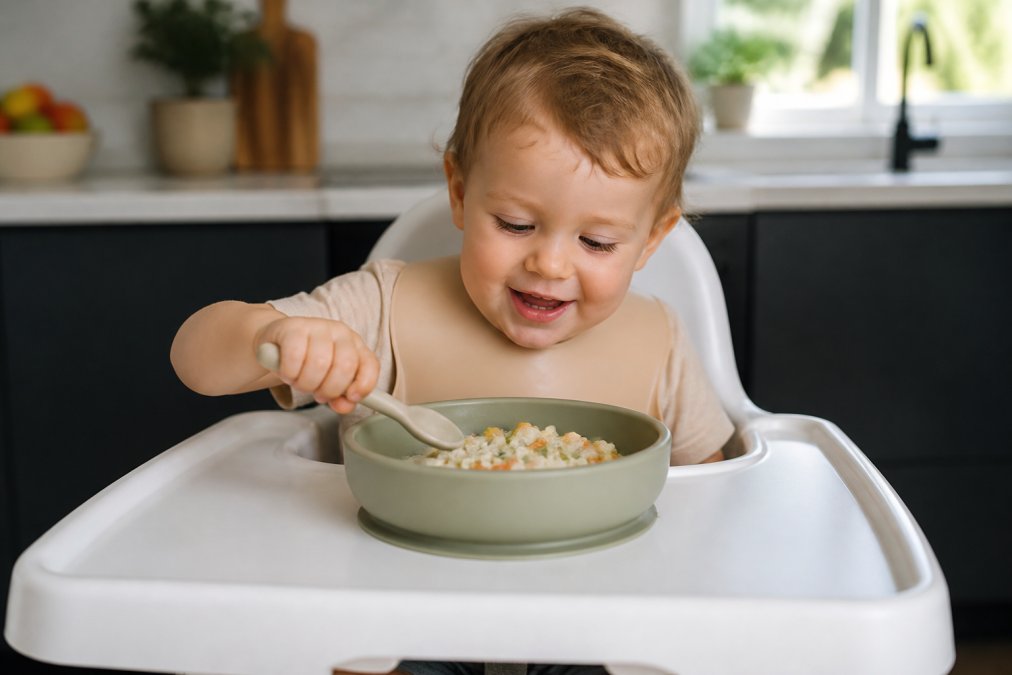
Silicone feeding sets support baby-led weaning and independent self-feeding by giving toddlers the tools they need to succeed at their own pace. The soft, flexible material is easy for small hands to grip, and the curved designs help little ones scoop food more effectively. The real advantage lies in how the design aligns with the stages of toddler motor development.
Stage 1 (6-9 Months): The Palmar Grasp and the 'Chunky' Handle
At this stage, babies use a whole-hand palmar grasp and cannot yet manipulate a thin utensil. The best spoons have short, thick, rounded handles that fit snugly in the fist. Silicone provides enough friction to prevent slipping, unlike smooth plastic. Look for a shallow, wide bowl, this allows food to stick without requiring precise lip closure, which is still developing. The suction bowl is non-negotiable, as it provides a stable platform for the 'raking' motion babies use to pull food toward them.
Stage 2 (9-15 Months): The Pincer Grip and the 'Scoop' Curve
As the pincer grip develops, toddlers begin to hold spoons with their fingers. A spoon with a slight curve or an indented thumb rest guides the hand into a more mature grip. The bowl should have a flat, angled edge that acts like a shovel, allowing the child to press down and scoop without rotating their wrist. This is why the curved design of the Pagi Kids bowl is so effective.

Stage 3 (15-24 Months): Wrist Rotation and the 'Load and Level' Technique
Older toddlers learn to 'load' the spoon and 'level' it by tapping it against the side of the bowl. A plate with a vertical inner wall or a 'loading ledge' supports this skill. The suction base remains vital, as the tapping motion can easily dislodge a non-secured plate. The transition to an open cup also begins here; a silicone cup with a weighted base and two handles allows the child to grip with both hands while the soft rim protects emerging teeth.
Why Silicone Beats Plastic for Motor Skill Development
The key difference is feedback. Silicone is slightly 'sticky' and has a higher coefficient of friction than plastic. This provides proprioceptive feedback, the sense of where the utensil is in space, which helps toddlers learn to control the spoon without looking at it. Silicone's flexibility also means it bends slightly under pressure, reducing the impact on gums and teeth when toddlers are teething.
1. Ultimate Set: The Complete 6-Piece Kit
The Bub and Co Ultimate Set is a comprehensive 6-piece kit priced at $44.95 that includes a plate with lid, suction bowl, bib, spoon, and fork, all made from BPA-free, food-grade silicone that is dishwasher and microwave safe.
What makes this set stand out is the completeness. Rather than piecing together individual items, you get a coordinated system where every component works together. The suction bases on the plate and bowl adhere firmly to clean, smooth highchair trays, and the included lid makes storing leftovers simple.
The spoon and fork are sized for toddler hands and soft enough to protect gums, while the bib catches the inevitable spills. For families who want one set that covers everything from spoon-feeding to self-feeding, this is a practical option.
2. Junior Set: A Cup-Complete Option for Growing Toddlers
The Junior Set, also priced at $44.95, is a choice for toddlers who are already drinking from a cup and need a set that grows with them. This bundle includes a suction plate, suction bowl, cup, and spoon, giving you everything required for a full meal without the bib.

The addition of the cup is the key differentiator. Toddlers transitioning from bottle to cup benefit from a cup designed for little hands, and having it match the rest of the set creates a cohesive mealtime experience. The suction plate and bowl keep food in place while your child practises scooping and self-feeding.
This set is particularly well suited to baby-led weaning, where easy-grip utensils and sectioned plates allow toddlers to explore finger foods and practise independent eating. Sized to work from around 6 to 8 months through the toddler years, it represents value for families who already own a bib.
3. Pagi Kids Feeding Set: Value-Packed Starter
For parents wanting a complete starter kit without the premium price, the Pagi Kids Feeding Set at $39.95 delivers value. This 4-piece set includes a pocket bib with reinforced eyelets, a suction bowl with a curved design for easier scooping, an ergonomic spoon, and a leakproof sippy cup with a detachable lid and inner straw for easier cleaning.
The material quality is good for the price point. Made from food-grade silicone that is hypoallergenic and completely non-toxic, this set is soft on your baby's skin and gentle on emerging teeth. The silicone withstands extreme temperature changes without melting or cracking.
The sippy cup deserves special mention. Its leakproof design, combined with the detachable lid and inner straw, makes it easy to clean thoroughly while supporting your toddler's transition to independent drinking. For families starting their solids journey, this set provides everything needed at a price that leaves room for additional purchases.
4. Mini Bub Set: Compact and Budget-Friendly Trio
The Mini Bub Set is our budget pick at $25.00, offering a bib, suction bowl, and spoon for families who want to start simple. This compact trio is designed for babies from around 6 months and is perfect for purees, mash, and small toddler portions.
The suction bowl features a cup to ensure it stays in place during meals, and both the bowl and bib are microwave and dishwasher safe. One important note: the spoon has a wooden handle, so it should be hand washed and kept out of the microwave to preserve the wood.
This set works well as a travel option or as a backup for grandparents' houses. It is also a sensible first purchase for parents unsure whether their baby will take to silicone tableware, allowing you to test the waters before committing to a larger bundle.
| Set | Price | Pieces Included | Best For |
|---|---|---|---|
| Ultimate Set | $44.95 | Plate with lid, bowl, bib, spoon, fork | Complete mealtime system |
| Junior Set | $44.95 | Plate, bowl, cup, spoon | Toddlers drinking from cups |
| Pagi Kids Set | $39.95 | Bib, bowl, spoon, sippy cup | Value starter kit |
| Mini Bub Set | $25.00 | Bib, bowl, spoon | Budget-friendly trio |
How to Clean Silicone Baby Plates: Stains, Odours and Care
Cleaning silicone baby plates properly comes down to acting quickly and using the right methods, which keeps them looking new and prevents odour buildup. Most silicone components are dishwasher safe, with the top rack recommended, but a quick rinse after meals helps prevent strongly coloured foods like tomato or curry from leaving marks.
For stubborn stains, warm soapy water and a soft sponge usually suffice. Avoid abrasive scrubbers, which can damage the silicone surface and make it more prone to future staining. If odours develop, soak the pieces in warm water and baking soda, which neutralises smells without leaving residue.
Hand washing is recommended for any parts with wooden handles, as noted with the Mini Bub Set spoon. For sippy cups with removable straws and valves, disassemble all parts before washing to ensure no residue hides in the crevices. With proper care, high-quality silicone resists stains and odours naturally, and these simple habits keep your feeding sets in top condition through multiple children.
The right silicone feeding set for your toddler comes down to matching the pieces to your child's stage and your family's routine. A complete set like the Ultimate Set offers the convenience of having everything coordinated, while the Mini Bub Set provides an affordable entry point for first tastes. Whichever you choose, prioritise food-grade silicone that is free from BPA, PVC and phthalates, and you will have dinnerware that is safe, durable, and easy to keep clean through the messiest stages of weaning.
Frequently Asked Questions
What age is a silicone feeding set for?
Most silicone feeding sets are designed for babies from around 6 months, when they start solids. The Mini Bub Set and Pagi Kids Feeding Set are suitable from this age. The Junior Set and Ultimate Set are sized to work through the toddler years, so you can use them from first purees until your child is eating full meals independently.
Are silicone feeding sets safe for babies?
Yes, when they are made from food-grade silicone. Look for sets that are free from BPA, PVC, and phthalates. Food-grade silicone is non-toxic, hypoallergenic, and does not leach chemicals when heated. It is also soft on gums and teeth, making it a safer choice than hard plastic or ceramic for toddlers learning to self-feed.
How do you clean and sanitise silicone feeding sets?
The easiest way is to place the silicone pieces on the top rack of your dishwasher. For hand washing, use warm soapy water and rinse well. Silicone is naturally resistant to stains and odours, but rinsing soon after strongly coloured foods like tomato or curry helps keep it looking fresh. You can sanitise by pouring boiling water over the pieces or using a steam steriliser.
What is the best silicone feeding set for a baby starting solids?
For a complete start, the My First Solid Bundle at $60.00 gives you a bib, suction bowl, spoon, sippy cup, suction plate, and placemat. If you prefer a smaller kit, the Pagi Kids Feeding Set at $39.95 includes a pocket bib, suction bowl, ergonomic spoon, and leakproof sippy cup. Both are made from BPA-free, food-grade silicone and support baby-led weaning.
How do I get the suction bowl to stick to the highchair tray?
For best suction, place the bowl on a clean, dry, flat surface. Press down firmly in the centre of the base to push out the air. Avoid textured or uneven tabletops, as suction bases need a smooth surface to grip properly. If it is not sticking, check that the base and tray are completely dry and free from food residue.
Choosing feeding gear that supports your child's development while simplifying your daily routine is the goal every parent shares. At Bub and Co, our silicone feeding sets are crafted from food-grade, non-toxic materials that resist stains and odours, with suction bases designed to stay put during enthusiastic self-feeding. Shop our collection of feeding sets, teethers, and bundles to find the perfect match for your little one's weaning journey.
Leave a comment