
Table of Contents
- Why Messy Mealtimes Are a Normal Part of Development
- Set Up Your Environment to Reduce Baby Mealtime Mess Before You Start
- Dress for the Mess: Clothing and Bibs That Contain Spills
- Use Suction Plates and Bowls to Stop Tipping and Throwing
- Serve the Right Portions and Food Sizes for Less Waste
- Baby Led Weaning Mess Management: What Actually Works
- How to Clean High Chair Mess Fast: A Daily Routine
- The Best Silicone Feeding Sets for Babies Who Love to Explore
- Managing Mess When You Are Out and About
- Transitioning from Messy to Independent Eating
- Frequently Asked Questions
Last Updated: September 9, 2026
Every parent knows the scene: pureed sweet potato on the ceiling, a bowl flipped in record time, and a high chair tray that looks like a crime scene. Mess is a developmental milestone, not a failure of your setup. Learning how to reduce baby mealtime mess isn't about stopping the chaos entirely; it's about channelling it so both you and your little one can enjoy the feeding journey. At Bub and Co, we design silicone products around the simple truth that a stress-free meal starts with gear that works with your baby's instincts, not against them.

Your goal is not a spotless floor but a baby who builds fine motor skills, explores food texture, and learns self-feeding confidence. The strategies below cut your cleanup time dramatically while protecting that developmental progress.
Why Messy Mealtimes Are a Normal Part of Development
Messy eating is your baby's first science experiment. Smearing yoghurt teaches viscosity; dropping food tests gravity and cause and effect. Smashing, squishing, and tossing are all part of sensory exploration, foundational for how children understand the world.
Paediatric feeding specialists generally agree that restricting this exploration can slow the development of independent eating skills. The mouth is the last stop in a long sensory chain; babies need to feel food with their hands before they feel it on their tongues. If you wipe their hands clean after every bite, you interrupt that learning loop.
The practical takeaway is that "mess prevention" should mean "mess containment." Reduce the radius of the disaster, not the sensory experience itself. This reframing alone reduces the stress you feel at every meal, which your baby picks up on.
Set Up Your Environment to Reduce Baby Mealtime Mess Before You Start
The most effective way to reduce baby mealtime mess is to engineer your environment before the high chair tray is loaded. A few minutes of setup saves twenty minutes of scrubbing later.
Start with the floor. A splat mat under the high chair is non-negotiable for baby-led weaning. Look for one that is wipeable and waterproof, not just machine-washable fabric, which holds odours. You want something you can spray down and wipe in seconds between meals.
Position the high chair away from walls and curtains where food can splatter. If you have a dog, this is the moment they earn their keep, though you will still want a mat for the food they miss.
Choose the Right High Chair and Tray
The high chair plays a bigger role in mess than most parents realise. A wide, stable base prevents tipping when your baby leans to grab food. The tray should sit flush against your baby's body with no gap where food can fall through.
A removable, dishwasher-safe tray is worth prioritising. You will wash this surface multiple times a day, and a tray requiring hand-washing will become a source of resentment. Wipeable surfaces on the chair seat, rather than fabric padding, also cut down on deep cleaning.
Dress for the Mess: Clothing and Bibs That Contain Spills
The right clothing strategy turns a potential outfit change into a quick wipe-down. During the messiest phases, peaking between 6 and 12 months, consider feeding your baby in just a nappy on warm days. This eliminates laundry entirely and allows full sensory exploration without wet fabric against their skin.
When you do use clothing, choose short sleeves or roll them up past the elbow. Long sleeves drag through food and create a mess reaching the wrist and forearm.
A good bib is your first line of defence, and not all bibs are equal. The Bub and Co Silicone Bib features a wide scooped base that catches food before it reaches clothing or the floor. The adjustable collar fits infants and toddlers alike, so it grows with your child. Like all our products, it is made from food-grade silicone and is free from BPA and PVC, so you are not trading cleanup convenience for chemical exposure.
Use Suction Plates and Bowls to Stop Tipping and Throwing
The single most effective piece of gear for reducing mess is a suction plate that actually stays stuck. Most "suction" products fail because they lose their grip on textured trays or after a few washes. A plate that tips is not just messy; it teaches your baby that throwing is a viable way to interact with food.
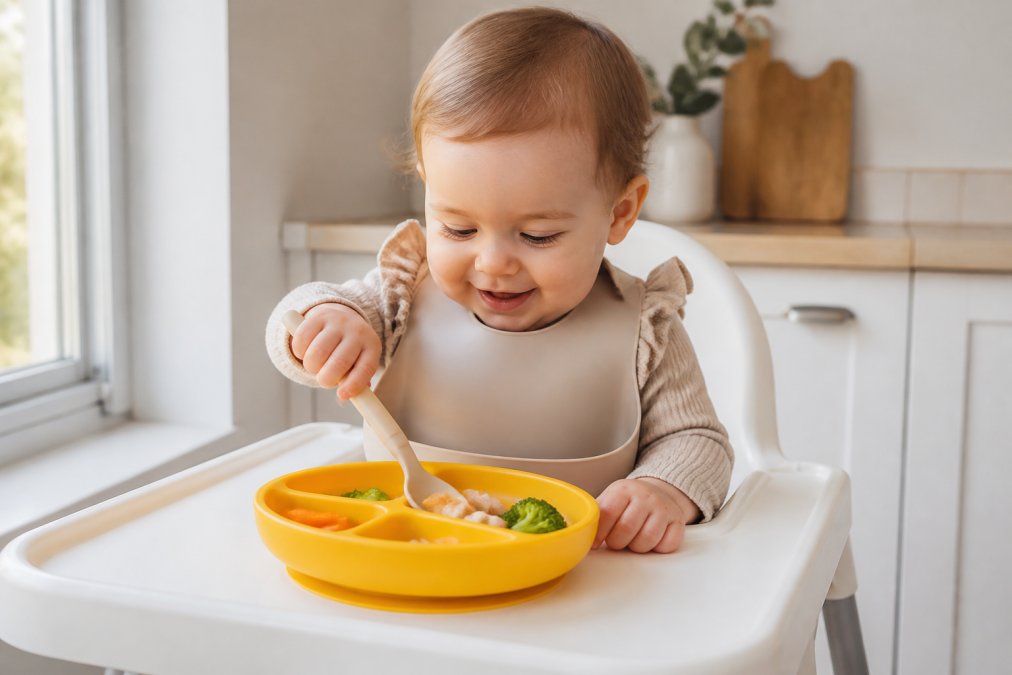
A quality suction plate should anchor firmly to the tray and resist your baby's strongest pull. The Bub and Co Non Grid Suction Plate is designed with deep walls that prevent spilling and make it easier for little hands to scoop food up. Deep walls are the detail most parents overlook: shallow plates let food escape over the edge with even a clumsy swipe.
Bub and Co Non Grid Suction Plate also skips the internal dividers found on many "sectioned" plates. While dividers look neat, they frustrate babies who want to mix textures and make scooping harder for developing fine motor skills. A single open surface gives your child room to explore while the suction base keeps the plate in place.
Serve the Right Portions and Food Sizes for Less Waste
Portion control is the cheapest mess-reduction strategy you have. Most parents load the tray with far more food than a baby can eat, then watch the excess get swept to the floor in one dramatic gesture.
Serve one or two pieces of food at a time. When your baby finishes those, add more. This reduces food waste dramatically and keeps your baby engaged because each new piece feels novel. A mountain of food invites playing and throwing; a single piece invites eating.
Food size matters just as much as quantity. Cut finger foods into shapes your baby can grip easily. For younger babies, offer sticks about the size of an adult finger that protrude from the fist. As their pincer grip develops, smaller pieces become appropriate. Food that is easy to hold is less likely to be crushed in frustration and flung aside.
Baby Led Weaning Mess Management: What Actually Works
Baby-led weaning mess management is a specific challenge because you are skipping purees and going straight to finger foods, which means more texture, more variety, and more mess from day one. The good news is that the mess follows a predictable curve and does taper off.
The messiest phase is the first two to three months, when your baby is still developing the hand-to-mouth coordination needed to eat what they pick up. During this window, expect a significant portion of food to end up on the floor, the chair, and your baby. This is not a sign that baby-led weaning is failing; it is the process working exactly as designed.
What actually reduces the mess over time is consistency. Babies learn through repetition that food belongs in their mouths, not on the floor. If you change your approach every few weeks because the mess feels overwhelming, you reset that learning clock.
For the floor under a baby-led weaning eater, invest in a proper splat mat. The Bub and Co Silicone Placemats serve double duty: place one under the high chair as a catch surface, or use it directly on the table in front of your baby. The non-slip backing keeps it in place, and the catch pocket stops food from rolling off the edge.

How to Clean High Chair Mess Fast: A Daily Routine
A fast cleanup routine separates parents who dread mealtimes from those who move through them smoothly. The goal is to make cleaning a reflex, not a decision you have to make each time.
Keep your cleaning supplies within arm's reach of the high chair. A spray bottle of food-safe cleaner and a stack of microfiber cloths in a nearby drawer means you can wipe down the tray before you even lift your baby out. Waiting even five minutes allows food to dry and crust, turning a thirty-second wipe into a five-minute scrub.
The routine that works for most families looks like this:
- Wipe the tray and high chair surfaces immediately after lifting your baby out, before food dries.
- Rinse the bib and suction plate under warm water, then wipe with a cloth.
- Pop the tray, bib, and plate in the dishwasher for the evening cycle.
- Shake the splat mat over the bin, then wipe it down with a damp cloth.
- Spot-clean the floor with a quick mop or cloth to catch any residue.
The key to making this routine stick is gear that survives it. Silicone products that are dishwasher safe and stain-resistant make the difference between a two-minute cleanup and a ten-minute ordeal. The Bub and Co Sun bowl with lid is designed for exactly this rhythm: it handles baby-led weaning portions during the meal, then the lid snaps on for storing leftovers in the fridge, eliminating a separate container and an extra wash.

| Cleaning Task | Best Tool | Time Needed | Frequency |
|---|---|---|---|
| High chair tray | Food-safe spray + microfiber cloth | 30 seconds | After every meal |
| Silicone bib | Warm water rinse or dishwasher | 10 seconds | After every meal |
| Suction plate/bowl | Dishwasher | 1 minute prep | After every meal |
| Splat mat floor cover | Wipe down with damp cloth | 30 seconds | After every meal |
| Deep clean of chair | Remove tray, wash crevices | 5 minutes | Weekly |
The Best Silicone Feeding Sets for Babies Who Love to Explore
When you are choosing gear to reduce baby mealtime mess, silicone is the clear winner over plastic and ceramic. Silicone is non-toxic, free from the BPA, PVC, and Phthalates that can leach from cheaper plastics, and it withstands both heat and cold without breaking down. It does not stain or hold odours the way plastic does after repeated exposure to tomato sauce and turmeric.
The best silicone feeding sets focus on the three failure points of mealtime: the plate that tips, the bib that soaks through, and the bowl that slides. A coordinated set that addresses all three will reduce your cleanup time more than any single product.
For most families, the core kit is a suction plate, a silicone bib, and a placemat. The Bub and Co Non Grid Suction Plate handles the main meal, the Silicone Bib catches what misses the mouth, and the Silicone Placemats protect the table or floor from the inevitable drops.
A common objection is whether silicone is worth the investment over cheaper plastic alternatives. The answer comes down to longevity. A plastic plate that stains, warps in the dishwasher, and loses its suction within months needs replacing frequently. A well-made silicone product survives the entire messy phase and often serves as a toddler bowl well past the weaning years. When you factor in the replacement cycle, silicone is the more economical choice.
Managing Mess When You Are Out and About
The mess does not disappear when you leave the house, but you can contain it with a slightly different toolkit. Dining out or visiting family requires a more portable approach.
Carry a compact silicone bib in your nappy bag at all times. The Bub and Co Silicone Bib rolls up small and wipes clean, so you can rinse it in a restaurant bathroom and use it again the same day. Fabric bibs are useless in this scenario because they need a full wash.
For restaurant high chairs, which are rarely as clean as your home chair, lay a silicone placemat down before your baby sits. This creates a hygienic, non-slip surface and catches a good portion of the food that would otherwise end up on the restaurant floor.
Transitioning from Messy to Independent Eating
The mess does not last forever, and recognising the transition point helps you adjust your approach. Most babies become noticeably neater eaters between 12 and 18 months, as their fine motor skills mature and their interest in food overtakes their interest in throwing it.
You will know your baby is transitioning when they start eating more than they drop, and when they begin to notice and react to food on their hands. This is the moment to start reducing the gear. Move from a full-coverage bib to a smaller one, and consider removing the splat mat for some meals to encourage more careful eating.
The transition also requires a shift in your role. Instead of pre-loading the tray, offer the plate and let your baby serve themselves with your help. This builds the decision-making skills that lead to independent eating. Expect some regression during growth spurts or teething; messy phases often return temporarily, and that is normal.
Mess management for travel and dining out follows the same principle as home: contain the mess without restricting the learning. A baby who is allowed to practice self-feeding in a restaurant will eventually eat neatly in public, but only if they get the practice at home first.
The goal across all of these strategies is a calm, stress-free feeding environment where your baby can develop a healthy relationship with food. When you stop fighting the mess and start managing it, mealtimes become something you look forward to rather than dread.
Reducing baby mealtime mess is less about finding a magic product and more about building a system: the right high chair setup, a suction plate that stays put, a bib that catches spills, and a cleanup routine that takes seconds. Every piece of the Bub and Co feeding range, from the Non Grid Suction Plate to the Silicone Bib, is designed to support that system with non-toxic, stain-resistant, and durable materials. Shop the feeding sets and give your little one the freedom to explore food without turning your kitchen into a disaster zone.
Frequently Asked Questions
How long are babies typically messy eaters?
Most babies are messy eaters from starting solids around 6 months until they develop better fine motor skills and hand-eye coordination, usually between 18 and 24 months. This period is a normal part of sensory exploration and self-feeding development. While the mess decreases as they master the pincer grasp and spoon use, expect some spills until around age two or three. Patience and a consistent cleanup routine make this phase manageable.
What is the best way to manage food throwing during mealtimes?
Food throwing is often a test of cause and effect, not just bad behaviour. To manage it, serve small portions and offer more only when they finish. If food lands on the floor, resist making a big reaction; simply say 'food stays on the table' and remove the thrown item for a minute. Using a suction bowl or plate can prevent accidental tipping, which reduces the urge to throw.
Are there specific feeding tools that help contain mealtime spills?
Yes, the right gear makes a significant difference. A silicone bib with a deep catch pocket traps dropped food and liquid before it hits the floor. A non-slip silicone placemat with a catch pocket protects the table surface. Suction plates and bowls with deep walls prevent tipping and make scooping easier for little hands, which reduces frustration-based messes.
Is messy eating a normal part of sensory development?
Absolutely. For babies, squishing, smearing, and dropping food is how they learn about texture, temperature, and cause and effect. It is a critical part of sensory exploration and builds a positive relationship with food. Restricting this exploration can lead to picky eating later. Focus on containing the mess with the right bibs and mats rather than stopping the behaviour.
Leave a comment