
Table of Contents
- How Long Do Silicone Baby Products Last? The Short Answer
- Signs of Silicone Degradation in Baby Products
- Silicone vs Plastic Baby Feeding Sets: Safety and Durability
- How to Clean Silicone Baby Feeding Sets to Extend Their Life
- Lifecycle of Specific Silicone Product Types
- When to Replace Your Silicone Baby Products
- Frequently Asked Questions
Last Updated: September 30, 2026
How Long Do Silicone Baby Products Last? The Short Answer
Most food-grade silicone baby products last between one and three years with daily use. That range comes down to three things: the quality of the silicone, how often you sterilise it, and how roughly it gets treated.
Parents want a straight number, and the honest answer is that silicone baby products are durable but not permanent. The material slowly breaks down from heat, oils, and repeated washing.
So how long do silicone baby products actually last in a busy household? For a spoon or bib used at every meal, expect around 12 to 18 months before you notice real wear. A plate or lunch box that sees less heat and friction can hold up for two to three years. Teethers sit somewhere in the middle, since they get chewed constantly.

Signs of Silicone Degradation in Baby Products
The clearest signs of silicone degradation are a tacky surface, a chalky residue, a lingering smell, and small cracks or splits. Once you see these, the material is losing its structural integrity.
Other common signs to watch for:
- Discoloration that won't wash out, especially orange or brown staining
- A chemical smell that stays after washing
- Cracks and splits near edges or where the item bends
- A cloudy or dull finish that used to be clear or bright
- Oil absorption, where greasy foods leave permanent marks
The White Bloom Phenomenon
A white, chalky film on silicone is called white bloom. It happens when minerals from hard water and leftover oils settle into the surface.
Micro-Tear Detection
Micro-tears are tiny splits you can only feel, not see. Run a clean finger along the edges and bend points of a spoon or bib.
Silicone vs Plastic Baby Feeding Sets: Safety and Durability
Silicone outlasts plastic for baby feeding sets and avoids the chemical concerns linked to some plastics. That is the short version. Here is the detail, including what actually determines how long each material survives.
Here's how the two compare:
| Feature | Food-grade silicone | Plastic feeding sets |
|---|---|---|
| Heat resistance | High, microwave and dishwasher safe | Lower, can warp or leach |
| Surface | Non-porous, resists stains | Can scratch and hold odours |
| Durability | 1-3 years with daily use | Often cracks or clouds sooner |
| Chemical safety | BPA-free, no phthalates | Varies by plastic type |
| Feel | Soft, flexible | Rigid |
| Failure mode | Surface bloom, micro-tears, tackiness | Cracking, clouding, warping |
Why Silicone Still Wears Out
Silicone is durable, not inert. Three mechanisms drive its decline:
- Thermal cycling. Repeated heating and cooling flexes the polymer network. Over hundreds of dishwasher cycles, the cross-links that hold the structure together can loosen, which shows up as a tacky or sticky surface.
- Oil absorption. Silicone is oleophilic, meaning it attracts and absorbs oils. Fatty foods and even skin oils migrate into the surface over time. This is why a well-used spoon can smell faintly of last night's curry even after washing.
- Mechanical fatigue. Chewing, bending, and scrubbing create micro-stress at edges and bend points. These accumulate into micro-tears long before anything is visible.
Not All Silicone Is Equal
The trade-off is cost. Silicone usually costs more up front. But because it lasts longer and cleans more easily, many parents find it works out cheaper over time.
How to Clean Silicone Baby Feeding Sets to Extend Their Life
To clean silicone baby feeding sets, wash them in warm water with mild soap, rinse well, and let them air dry fully. Skip harsh scrubbers and strong chemicals, which wear down the surface faster.
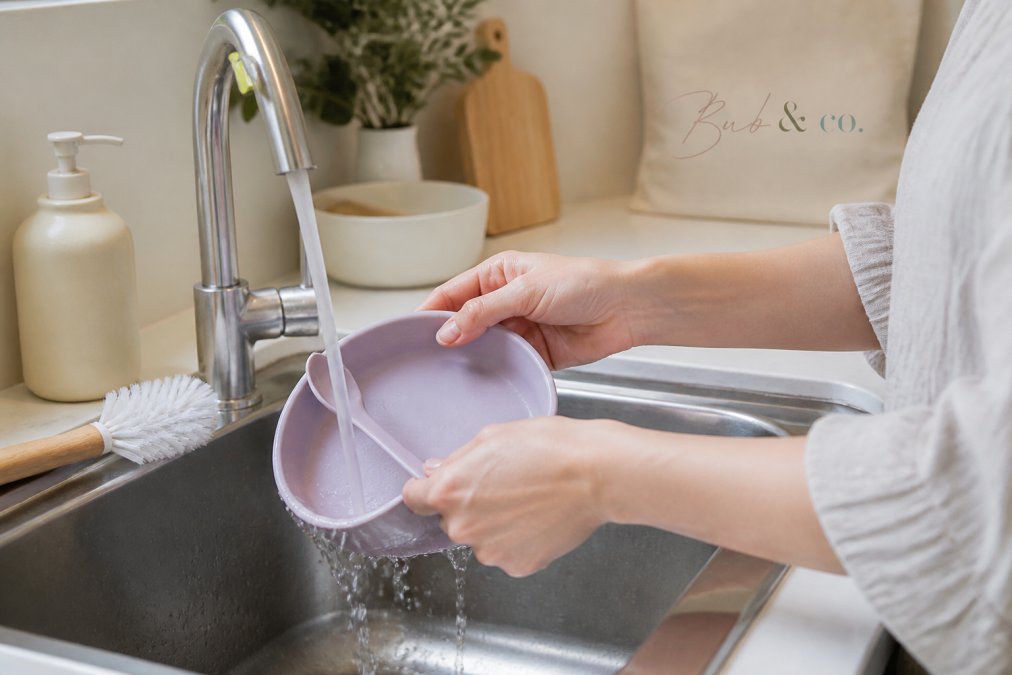
A simple routine keeps silicone in good shape:
- Rinse straight after meals to stop food residue setting
- Wash with mild soap and a soft sponge
- For stains, soak in warm water with a little white vinegar
- Air dry completely before storing
- Avoid sharp tools and abrasive pads
Sterilisation Protocols That Actually Work
Boiling water and steam sterilising both work for silicone, but frequency matters more than method. Sterilise new items before first use, then only as needed.
Here's what actually protects the material:
- Boiling: submerge for a few minutes, no longer. Long boils speed up breakdown.
- Steam: follow the steriliser's guide and avoid repeated cycles beyond what's needed.
- Dishwasher: a hot wash cycle does the job for most daily cleaning.
Boiling vs Steam vs Dishwasher: The Trade-Offs
Each method stresses silicone in a different way. The table below sets out what actually happens to the material, so you can match the method to the item and its age.
| Method | Temperature range | Stress on silicone | Best for |
|---|---|---|---|
| Boiling | ~100°C | High thermal shock at the surface; repeated cycles loosen cross-links | New items, deep clean after illness |
| Steam steriliser | ~95-100°C, moist heat | Gentler than boiling because heat is even and brief | Daily newborn-stage sterilising |
| Dishwasher (hot cycle) | ~60-70°C wash, higher on heated dry | Low per cycle, but cumulative over hundreds of washes | Everyday cleaning for older babies |
| Cold-water sterilising solution | Ambient | Minimal thermal stress, but chemical residue risk if not rinsed | Travel and items that can't take heat |
A few practical rules fall out of this:
- New items: one sterilisation before first use is enough. There is no benefit to boiling repeatedly in the first week.
- After illness: a boil or a full steam cycle is worth it. This is the one time the extra heat is justified.
- Daily use: a hot dishwasher cycle or a thorough soap wash does the same job with far less cumulative stress.
- Heated dry: skip it where you can. The dry cycle is often the hottest part of the wash and adds wear without adding cleanliness.
The Over-Sterilisation Trap
A common pattern is parents sterilising every spoon and plate after every meal well past the newborn stage. The intention is good, but the effect is cumulative thermal stress on a material that is already being flexed and chewed daily. Silicone that is boiled several times a week will typically show tackiness and bloom months earlier than the same item washed in soap and warm water.
Lifecycle of Specific Silicone Product Types
Different silicone items wear at different speeds, so it helps to know what to expect from each. A spoon faces heat and chewing. A lunch box mostly faces washing. That changes the timeline.
| Product type | Typical lifespan | Main wear factor |
|---|---|---|
| Spoons and forks | 12-18 months | Heat and chewing |
| Bibs | 1-2 years | Washing and folding |
| Plates and bowls | 2-3 years | Heat and suction use |
| Teethers | 6-12 months | Constant chewing |
| Lunch boxes | 2-3 years | Washing and sealing |
When to Replace Your Silicone Baby Products
Replace silicone baby products when you spot a tacky surface, a returning chalky bloom, a chemical smell, or any cracks and micro-tears. If a piece fails two or more of these checks, retire it.
A quick replacement cycle to follow:
- Teethers: every 6-12 months, or sooner if chewed heavily
- Spoons and forks: every 12-18 months
- Bibs: every 1-2 years
- Plates, bowls, and lunch boxes: every 2-3 years
Frequently Asked Questions
How long do silicone baby products last before needing replacement?
Most food-grade silicone baby products last between 6 and 24 months with regular use, depending on the item and how well you care for it. Teethers and spoons that get chewed daily tend to wear faster than plates or bibs. Replace any silicone baby product as soon as you notice cracks, splits, a persistent chemical smell, or a tacky surface that won't come clean.
Does food-grade silicone have an expiry date?
Food-grade silicone doesn't carry a printed expiry date, but it does have a practical lifespan. The material degrades gradually through repeated heating, washing, and exposure to oils and acidic foods. Once you spot chalky residue, discolouration, or micro-tears, the structural integrity is compromised. At that point, the product should be retired even if it still looks mostly intact.
How can you tell if silicone baby spoons are degrading?
Run your fingers over the spoon's surface. A healthy spoon feels smooth and dry. Degrading silicone feels tacky, sticky, or slightly greasy even after washing. Other signs include a white chalky film, faint cracks at the tip, a lingering smell after cleaning, or discolouration that won't lift. Any of these mean it's time to replace the spoon.
How do you properly sanitise silicone baby products to extend their life?
Wash items first in warm soapy water to remove food residue and oil. Then sanitise by boiling in water for 5 minutes, steaming, or using a dishwasher on a hot cycle if the product is dishwasher safe. Avoid bleach-based soaking, abrasive scrubbers, and direct contact with heating elements. Let items air dry completely before storing to prevent musty odours.
Silicone baby products don't last forever, and knowing when to let one go is what keeps mealtimes safe. Bub and Co makes that easy with food-grade silicone feeding sets that are free from BPA, PVC, and Phthalates, plus stain-resistant and odour-free designs that hold up to daily use. Our products withstand heat and cold without leaching chemicals, so you can sterilise, wash, and reuse with confidence. Get started with Bub and Co and give your little one feeding gear built to last.
Leave a comment