
Table of Contents
- What to Look for in a High Chair for Small Spaces
- Why High Chair Footrest Importance Matters for BLW
- Easy to Clean High Chairs for BLW: What Actually Works
- High Chair Safety Standards Australia: What to Check
- Space-Saving Designs: Foldable, Clip-On and Convertible
- Vertical Storage and Aesthetic Integration in Small Apartments
- Frequently Asked Questions
Last Updated: September 12, 2026
What to Look for in a High Chair for Small Spaces
Finding the best baby led weaning high chairs for small spaces comes down to one hard truth: for baby led weaning high chairs, footprint matters more than almost any other feature. At Bub and Co, we hear from parents constantly who bought a beautiful full-size chair, then discovered it swallowed half their dining area.
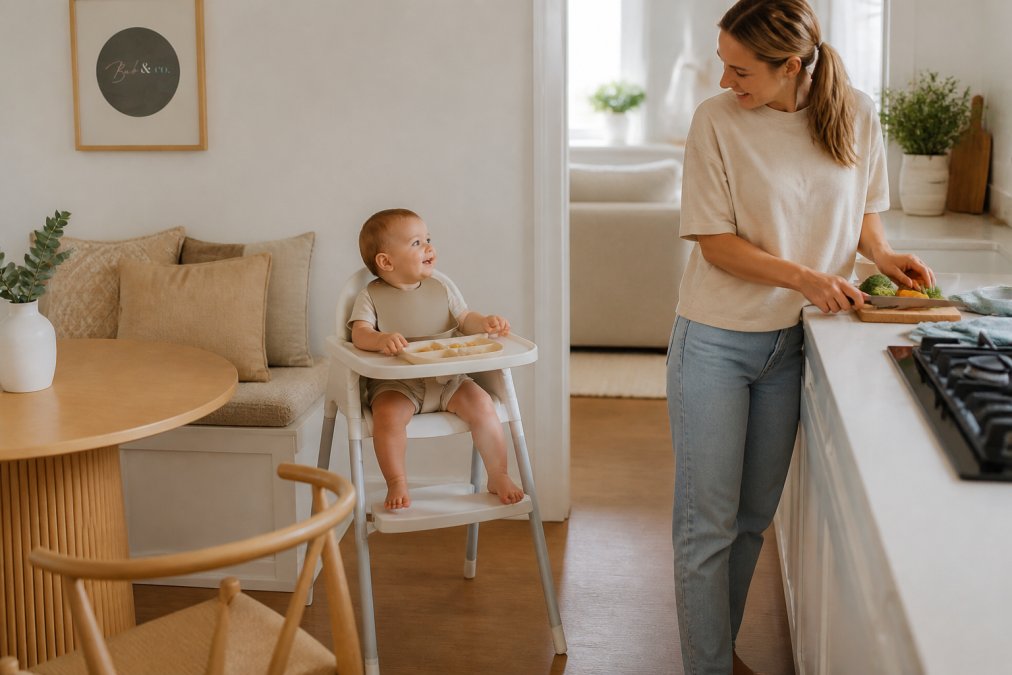
Most "best high chair" lists assume a sprawling kitchen. They don't tell you the seat depth, the folded dimensions, or whether the tray comes off one-handed while you're holding a slippery baby. Below, we break down what separates a chair that works in a small space from one that becomes an expensive obstacle.
Footprint and Floor Space
Measure your floor space before you look at any chair. A high chair's footprint is the area its legs occupy when fully open, the number that decides whether your chair fits or fights your kitchen.
Look for a compact base that stays stable without splaying wide. A non-slip base helps too, because a chair that shifts on tiles forces you to leave extra clearance you don't have. Foldable designs reclaim that space between meals.
Seat Depth, Back Support and Adjustable Footrest
Seat depth and back support determine whether your baby sits upright or slumps. For baby led weaning, upright posture isn't a preference; it's a safety and swallowing requirement.
An adjustable footrest is the feature most budget chairs skip, and the one you'll miss most. Without foot support, babies brace against the tray and slide forward. Seat depth should let hips sit back with knees bending naturally over the edge.
Why High Chair Footrest Importance Matters for BLW
High chair footrest importance comes down to stability. A footrest gives your baby a solid platform to push against, keeping the torso upright and the airway open during eating. Skip it, and you'll spend every meal repositioning a sliding, frustrated baby.
The 90-90-90 Rule and Upright Posture
The 90-90-90 rule is the positioning guideline that hips, knees and ankles each sit at roughly 90 degrees. When all three align, your baby's core is engaged, their airway is clear, and their hands reach the tray comfortably.
This is the single biggest reason a footrest is worth paying for. A baby propped with dangling feet can't self-feed efficiently. They're working against gravity instead of focusing on the food.
Easy to Clean High Chairs for BLW: What Actually Works
Easy to clean high chairs for BLW share one trait: few crevices. Baby led weaning is messy by design, and every seam, strap and textured surface becomes a hiding place for mashed banana. In a small space, cleaning is harder, you can't swing the chair around or hose it down outside, and it's often wedged between a wall and a bench.
The Features That Do the Heavy Lifting
- A removable tray insert that lifts off one-handed. You can carry it to the sink while still holding a baby. Look for a release you can operate with one hand, not a two-handed clip.
- A smooth, wipeable seat with no deep seams. Deep seams and textured plastic trap purée. A single moulded seat shell is easier than a padded, stitched one.
- A harness you can remove. Some chairs let you unclip the whole harness for washing. That's a major advantage over fixed webbing.
- A tray with a raised lip. A deeper tray contains more mess instead of letting it run onto the floor, which matters when the chair is against a wall.
- No fabric. Fabric seat covers and padded inserts are the single biggest cleaning liability in a BLW chair. If you must have one, choose one that's machine-washable and buy a spare.
Real-World Cleaning Hacks for Tight Corners
Tight corners are where cleaning routines break down. You can't swing a chair around in a galley kitchen, so work with the space you have. These tactics hold up in a compact home.
1. Clean the food traps before they set. The worst traps in a compact chair are the hinge points on folding models, the gap between the seat shell and the frame, and the underside of the tray rim. Wipe these immediately after the meal, while food is still soft, once banana and oat porridge dry, they bond to plastic and need soaking.
2. Use a two-cloth system. Keep one damp microfiber cloth and one dry cloth within arm's reach. Wipe with the damp cloth, then dry with the second, drying stops water pooling in hinge points, which causes rust and stiff folding mechanisms over time.
3. Steam-clean the crevices. A handheld steam cleaner reaches hinge gaps and tray rims a cloth can't, and is especially useful on folding chairs. Check the manufacturer's guidance first, some finishes don't tolerate steam.
4. Slide a washable mat under the chair. A silicone or wipe-clean mat catches most dropped food. In a tight corner, size it to the chair's footprint rather than the full floor, so it doesn't curl up against the wall.
5. Use a silicone bib with a catch pocket. This cuts floor cleanup dramatically and is the single highest-impact change most parents make.
6. Vacuum the floor gap weekly. In a small kitchen, crumbs accumulate in the gap between the chair and the wall or bench. A crevice tool on a vacuum reaches where a broom can't.
7. Disassemble monthly. Take off the tray, unclip the harness and wipe inside the frame joints. Most parents skip this step, and it's the one that prevents a permanent smell.
What to Avoid
- Textured plastic seats. They look grippy but trap food in every dimple.
- Fabric straps that can't be removed. Webbing soaks up purée and is very hard to clean in place.
- Tray inserts with deep grooves. They're harder to wipe than a flat tray with a raised lip.
- Chairs with exposed screws or rivets on the seat surface. Food packs around them and they're fiddly to clean.
The short version: the best BLW chair for a small space is one you can wipe down in under two minutes without moving it. If cleaning takes longer, you'll stop doing it properly and the chair will start to smell.
High Chair Safety Standards Australia: What to Check
High chair safety standards in Australia are set out in the voluntary standard AS 4684, which covers stability, restraints and structural integrity. Always confirm a chair meets this standard before buying, and check the current requirements through Product Safety Australia.
A five-point harness, a non-slip base and a stated weight limit are the three features to verify first. Together they address the most common failure points in real-world use.
Five-Point Harness, Non-Slip Base and Weight Limit
A five-point harness restrains the shoulders, hips and between the legs, stopping a determined baby from climbing or sliding out. A non-slip base keeps the chair planted when your baby pushes off the tray.
The weight limit tells you how long the chair lasts. A higher limit usually means a sturdier frame, which matters if you plan to use the same chair for a second child.
| Feature to Check | Why It Matters | What to Look For |
|---|---|---|
| Five-point harness | Prevents climbing and sliding out | Shoulder, hip and crotch straps |
| Non-slip base | Keeps chair stable on tiles | Rubberised feet or grips |
| Adjustable footrest | Supports upright posture | Multiple height positions |
| Removable tray | Speeds up cleaning | One-handed release |
| Weight limit | Determines usable lifespan | Higher limit for multiple children |
Space-Saving Designs: Foldable, Clip-On and Convertible
Space-saving designs fall into three broad types. A foldable design collapses flat for storage between meals. A clip-on chair attaches to your dining table and takes up zero floor space. A convertible chair grows from infant insert to toddler seat, so you buy once.
The trade-offs are real. Clip-on chairs depend on a table edge that can take the load and won't tip. Foldable chairs are compact but often have fewer adjustments. Convertible chairs last longest but usually have the largest footprint. For a genuinely tiny space, a portable high chair that folds flat is the better pick.
Vertical Storage and Aesthetic Integration in Small Apartments
Most high chair guides stop at footprint. They tell you the chair folds, then leave you to work out where it actually goes in a 48-square-metre apartment. This section fills that gap: vertical storage, and the aesthetic reality of living with a high chair in a small home.
Vertical Storage: Where the Chair Goes Between Meals
A folded high chair still occupies floor space unless you lift it off the floor. Vertical storage means hanging it on a wall hook, tucking it behind a door, or sliding it beside the fridge, anywhere it stops competing with your feet.
Three things determine whether a chair can be stored vertically:
- Folded depth. Look for a folded profile under about 20 cm. Anything deeper won't sit flush against a wall or slip behind a standard interior door, which is typically around 35 mm thick with a 10-15 mm gap at the top.
- Folded weight. A chair you can lift one-handed while holding a baby needs to be light. Most compact chairs land somewhere between 5 kg and 9 kg; anything over 10 kg becomes a two-hand job and you'll stop bothering.
- A hang point. Some chairs have a built-in loop, strap or moulded hook. If yours doesn't, a wide, rubber-coated utility hook rated well above the chair's weight is the usual workaround, check the hook's stated load rating rather than guessing.
A common pattern among apartment parents is a hook on the inside of a pantry or laundry door. The chair swings out of the way, the door still closes, and the floor is clear for the pram, the nappy bin and everything else competing for space.
Aesthetic Integration: Why It Matters More Than Parents Admit
In a small apartment, every object is visible from the couch. A high chair that clashes with your kitchen isn't just functional, it's furniture you look at three times a day. Many parents quietly decide on this, even when they frame it as practical.
A few concrete things to look for:
- Neutral or muted tones. White, warm grey, natural wood and matte black disappear into most small interiors. Bright primary colours and cartoon prints dominate a room.
- A slim silhouette. Chairs with a single central stem or narrow A-frame legs read as lighter than chairs with four splayed legs, even when the footprint is similar.
- Materials that age well. Timber and powder-coated metal wipe clean and don't yellow. Cheap glossy plastic scratches and dulls within months, which is more noticeable in a small space.
- No unnecessary bulk. A chair with a large, permanently attached tray and a bulky recline mechanism takes up visual space even when folded.
Long-Term Durability: Buying Once for Two Children
A small-space chair is an investment, because you don't have room to store a second one. Features that signal it will survive a second child:
- A metal or solid timber frame rather than hollow plastic, which cracks at stress points over time.
- Harness webbing that stays firm after repeated wiping. Frayed or softened webbing is a sign the chair has reached the end of its safe life.
- Replaceable parts. Some manufacturers sell replacement trays, harnesses and footrests individually. That extends the chair's life and is worth checking before you buy.
- A weight limit that comfortably exceeds your toddler's expected weight. A higher limit usually reflects a sturdier frame, not just a marketing number.
For a genuinely tiny space, a chair that folds flat and stores vertically is the better pick, but only if the frame and harness are built to last. A cheap folding chair that wobbles by the second child is a false economy.
Frequently Asked Questions
What is the best baby high chair for small spaces?
Look for a compact footprint, a foldable design and a tray that sits close to the seat so it doesn't push out into walkways. A clip-on chair or a chair with a table-clamping mechanism can free up floor space entirely. Measure your dining area first, then check the chair's folded dimensions, not just its assembled size, so you know it fits when stored.
What is the 90-90-90 rule for high chairs and why does it matter for BLW?
The 90-90-90 rule means hips, knees and ankles are each bent at roughly 90 degrees, with feet flat on a footrest. This upright posture gives your baby the stability to manage food safely during baby led weaning. Without foot support, many babies slump or push against the tray, which makes gagging and choking more likely. An adjustable footrest is the simplest way to maintain this position as your baby grows.
Do I need a footrest for my baby's high chair?
Yes. A footrest is not a nice extra, it is a core safety feature for baby led weaning. Feet resting flat give your baby a stable base, which supports upright posture and better chewing control. Chairs sold without a footrest often leave a baby's legs dangling, which encourages slouching. If your chair has an adjustable footrest, set it so knees and ankles sit at roughly 90 degrees.
Which high chairs are best for small babies just starting solids?
Newer sitters need a chair with good back support, a snug seat depth and a five-point harness to hold them upright. An infant insert or newborn insert can help smaller babies sit safely until they fill out the seat. Pair that with an adjustable footrest and a dishwasher-safe tray, and you have a setup that works from the first spoonful through toddlerhood.
Leave a comment