
Table of Contents
- Signs Baby Is Ready for Solids
- Why Silicone Spoons Are Recommended for Starting Solids
- Silicone vs Plastic Baby Spoons
- How to Pre-Load a Spoon for Self-Feeding
- How to Clean Silicone Feeding Sets
- Troubleshooting Common Spoon-Rejection Behaviours
- Frequently Asked Questions
Last Updated: September 28, 2026
Signs Baby Is Ready for Solids
Most babies show they are ready for solids between four and six months, but age alone is not the signal. Watch for skills, not the calendar. This guide from Bub and Co walks you through how to introduce solids with silicone spoons for beginners, starting with the signs that matter most.
Signs baby is ready for solids include sitting upright with minimal support, steady head and neck control, and showing real interest in what you are eating. Your baby should also have lost the tongue-thrust reflex that pushes food back out.
Developmental Milestones That Matter
Three milestones decide whether starting solids will go smoothly:
- Sitting with support and holding the head steady
- Reaching and grasping for objects and bringing them to the mouth
- Showing chewing motions even before teeth appear
If your baby can do all three, they are likely ready. If not, wait a few weeks and try again.
What to Do If Your Baby Isn't Ready Yet
There is no rush. Many babies need a few extra weeks before they are ready.
Keep offering tummy time to build neck strength.
Why Silicone Spoons Are Recommended for Starting Solids
Silicone spoons are recommended because they are soft on tender gums, free from BPA, PVC and phthalates, and gentle if your baby bites down during feeding. That combination makes them the safest first utensil for most families.
Soft-Tip Spoons and the Gag Reflex
A gag reflex is normal and protective. It sits far forward on a baby's tongue in the early months, so it triggers easily.
Sensory Processing and Texture Aversion
Some babies reject certain textures before they reject the food itself. This is common and rarely permanent.
Silicone vs Plastic Baby Spoons
Silicone beats plastic for first spoons because it stays soft, resists staining, and does not leach chemicals when heated. Plastic spoons are cheaper and stiffer, which works better once your baby has a stronger grip and more control.
| Feature | Silicone Spoons | Plastic Spoons |
|---|---|---|
| Feel on gums | Soft, flexible | Firm, can feel hard |
| Heat tolerance | Withstands heat and cold without leaching | Can warp or leach over time |
| Staining and odour | Stain-resistant and odour-free | Can stain and hold smells |
| Cleaning | Dishwasher safe | Dishwasher safe |
| Best stage | First foods, teething | Older babies with a firm grip |
What "Food-Grade Silicone" Actually Means
Food-grade silicone is a synthetic polymer built around a silicon-oxygen backbone. That backbone is what makes it stable: it does not readily break down into smaller chemical fragments the way some carbon-based plastics can when exposed to heat, fats, or acidic foods.
- No plasticiser smell when you open the packet. A strong chemical odour is a warning sign.
- Flexible but springy. It should bend and return to shape, not stay creased or feel greasy.
- Heat tolerance stated on the packaging. Most food-grade silicone handles the temperature range of a dishwasher and a steriliser without deforming.
- No filler chalkiness. Low-quality silicone is sometimes bulked out with fillers that make it stiffer and less heat-stable.
Why Heat Resistance Matters More Than Parents Expect
A first spoon gets exposed to more heat than most baby gear. It goes through the dishwasher, gets sterilised, sits in a warm bowl of puree, and sometimes gets left in a hot car.
When Plastic Still Has a Place
Plastic is not automatically the wrong choice. Once your baby has a reliable grip and is scooping independently, a firmer plastic or stainless-steel spoon can give better feedback and hold more food.
A Note on Sustainability
Silicone is not biodegradable, so it is not a perfect environmental answer. It is, however, long-lasting and does not shed microplastics into food the way some degraded plastics can. Buying one well-made set and using it across two children usually beats replacing cheap spoons every few months.
How to Pre-Load a Spoon for Self-Feeding
Pre-loading means putting food on the spoon for your baby, then handing it over so they can bring it to their own mouth. It builds self-feeding skills without the frustration of scooping too early.
My First Solid Bundle – Baby Silicone →
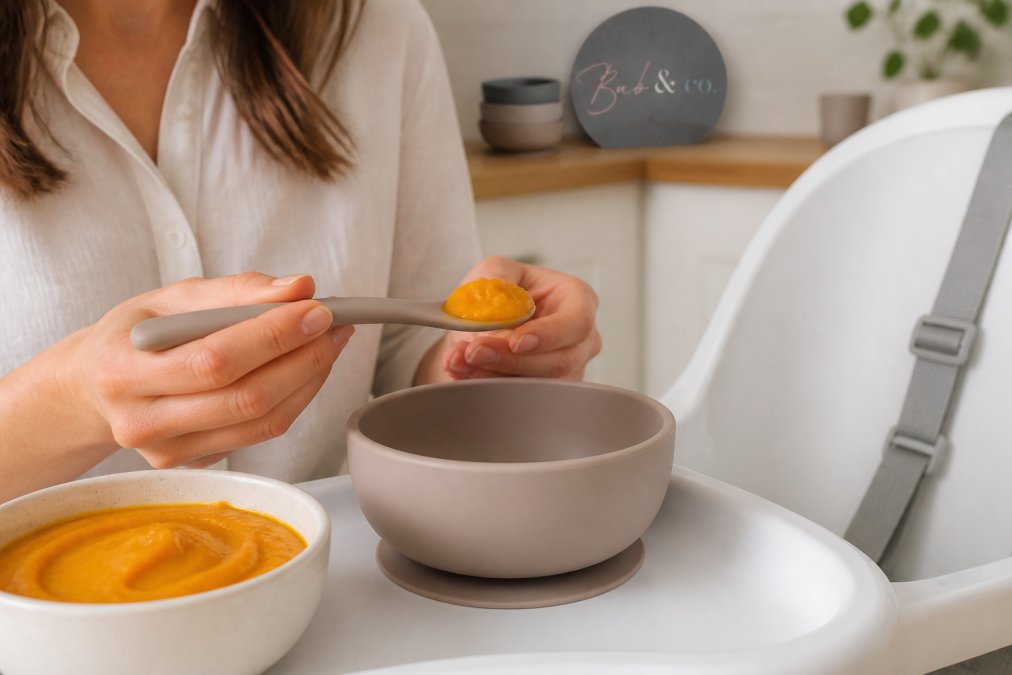
Follow these steps:
- Secure a suction bowl to a clean, dry tray so it does not slide.
- Scoop a small amount of food onto the spoon, about a thumbnail's worth.
- Hand the spoon to your baby with the handle facing them.
- Let them grasp it and guide it to their mouth, even if it is messy.
- Reload the spoon each time they hand it back or drop it.
- Offer a second spoon so there is always one ready.
Match the Spoon to the Motor Skill Stage
Most spoon-rejection and mealtime frustration comes from handing a baby a spoon that does not fit the grip they have actually developed. Spoon design features map fairly predictably to motor milestones.
| Stage (roughly) | Grip pattern | What the spoon needs |
|---|---|---|
| 4-6 months | Palmar grasp, whole hand | Short, chunky handle; very shallow bowl; soft tip |
| 6-9 months | Radial palmar grasp | Short handle with a textured or contoured grip; shallow bowl |
| 9-12 months | Pincer grasp emerging | Slightly longer handle; deeper bowl for scooping |
| 12-18 months | Refined pincer and wrist rotation | Standard-length handle; deeper bowl; firmer material |
A few design details worth checking:
- Handle length. A handle longer than your baby's forearm gives them a lever they cannot yet control, so it swings and drops. Short handles suit early palmar grasps.
- Bowl depth. A deep bowl holds more food but is harder to empty with the lips. Shallow bowls suit beginners; deeper bowls suit scoopers.
- Handle thickness. A thin handle is hard for a whole-hand grasp to hold. Chunky, slightly tapered handles are easier to keep hold of.
- Symmetry. A symmetrical spoon can be held either way up, which reduces the number of failed attempts in the early weeks.
The Hand-Over-Hand Technique
If your baby grabs the spoon but cannot yet aim it, place your hand over theirs and guide the motion gently toward their mouth. Do this for a few bites, then release and let them try alone.
Baby-Led Weaning vs Spoon-Feeding: Finding Your Approach
Baby-led weaning means offering soft finger foods and letting your baby feed themselves from the start. Spoon-feeding means you hold the spoon and your baby eats from it.
How to Clean Silicone Feeding Sets
How to clean silicone feeding sets is simple: wash with warm soapy water after each use, or place dishwasher-safe pieces on the top rack. Silicone does not hold onto smells or stains the way plastic can.
A quick routine:
- Rinse food off straight after the meal.
- Wash in warm soapy water, or use the dishwasher for dishwasher-safe pieces.
- Check suction bases and straw valves for trapped food.
- Air dry fully before storing.
Troubleshooting Common Spoon-Rejection Behaviours
Spoon rejection is usually a stage, not a verdict. Most babies push a spoon away because of timing, texture, or teething discomfort rather than the spoon itself.
Common problems and fixes:
| Problem | Likely Cause | What to Try |
|---|---|---|
| Turns head away | Not hungry yet | Wait 20 minutes and retry |
| Bats the spoon down | Wants control | Hand over a pre-loaded spoon |
| Gags on every bite | Texture too thick | Thin the puree slightly |
| Chews the spoon only | Teething | Offer a chilled silicone teether first |
| Spits food out | New flavour | Reoffer the same food for a few days |
Frequently Asked Questions
Are silicone spoons safe for babies?
Yes, when they are made from food-grade silicone free from BPA, PVC and phthalates. Silicone spoons are soft on gums, heat-resistant and do not leach chemicals when microwaved or washed in hot water. Check that the spoon is flexible, has no cracks and is labelled food-grade. Replace any spoon that becomes sticky, torn or discoloured, because damaged surfaces can harbour bacteria.
At what age should I start using a spoon for solids?
Most babies show readiness signs around 6 months, including sitting with minimal support, good head control, and showing interest in food. Some start closer to 4 months if a paediatrician advises it. Watch for the ability to move food to the back of the mouth rather than pushing it out with the tongue. Start with a soft-tip silicone spoon and small amounts of puree or mash.
How do I clean and sanitise silicone baby spoons?
Wash silicone spoons in warm soapy water after each use, or place them on the top rack of the dishwasher if the product is dishwasher-safe. For deeper cleaning, boil them in water for 5 minutes or use a steam steriliser. Avoid abrasive scrubbers that scratch the surface. Check the spoon weekly for cracks or a sticky film, and replace it if you notice either.
Why are silicone spoons recommended over plastic for starting solids?
Silicone is softer on gums, which helps with teething discomfort, and it does not contain BPA, PVC or phthalates. Plastic spoons can be harder and may crack or leach chemicals when heated. Silicone is also heat-resistant, stain-resistant and odour-free, so it holds up better to repeated washing and microwave use. For babies learning to self-feed, the flexible tip is gentler on the mouth.
Starting solids brings mess, gagging and the odd flung spoon. That is normal, and it passes.
Bub and Co makes the early weeks easier with food-grade silicone feeding sets that are stain-resistant, odour-free, and safe in the heat and cold. The soft-tip spoon protects gums, the suction bowl stays put, and every piece is dishwasher safe for fast cleanup. Get started with Bub and Co and give your baby a calm, confident first taste of real food.
Leave a comment