
Table of Contents
- Quick Comparison: Silicone Suction Plates and Feeding Sets
- Silicone Suction Plate Benefits for Babies and Toddlers
- The Best Baby Feeding Sets Australia Parents Actually Use
- How to Clean Silicone Baby Plates Without Damaging Them
- Suction Strength Testing: Why Plates Fail on Textured Trays
- Divided vs Open Plates and Age-Appropriate Progression
- Sustainability and End-of-Life for Silicone Tableware
- Conclusion
- Frequently Asked Questions
Last Updated: September 19, 2026
Quick Comparison: Silicone Suction Plates and Feeding Sets
Choosing a first feeding set comes down to one question: how much mess can you live with while your baby learns? Silicone suction plates are the practical answer, because a plate that stays on the tray means less food on the floor and more in your baby.
Here is the range at a glance.
| Product | Price | Best For |
|---|---|---|
| Non Grid Suction Plate | $14.95 | Open-plate eating and scooping practice |
| Rainbow Suction Plate with Lid | $17.95 | Portioning and meals on the go |
| Pagi Kids Feeding Set | $39.95 | A complete first-solids kit |
| Junior Set | $44.95 | Toddlers moving to independent eating |
| Ultimate Set | $44.95 | A full matching setup for every meal |
| My First Solid Bundle | $60.00 | Everything for starting solids in one box |
Silicone Suction Plate Benefits for Babies and Toddlers
Food-grade silicone is a rubber-like material made from silica, and it is why suction plates work so well for early eaters. It is soft on gums, holds its shape through heat and cold, and grips smooth surfaces without scratching them.

Less Mess, More Independence
A plate that slides across the tray teaches a baby that food is something to chase. A plate that stays put lets them focus on the harder skill: getting food onto the spoon and into their mouth. Deep walls and a firm suction base keep food where it is put, so your baby can practise scooping without the plate tipping, and babies who can rely on a still plate tend to attempt self-feeding sooner.
Safe Materials and Temperature Tolerance
Silicone withstands heat and cold without leaching chemicals, which matters when reheating puree or freezing portions. Bub and Co silicone is free from BPA, PVC and phthalates, and is stain-resistant and odour-free by design.
The Best Baby Feeding Sets Australia Parents Actually Use
The best feeding set matches your baby's current stage, not the one with the most pieces.


Non Grid Suction Plate ($14.95)
The simplest place to start is a single open plate. Deep walls keep food contained and make scooping easier for small hands, and it is the lowest-cost way to test whether suction works for your setup.
Rainbow Suction Plate with Lid ($17.95)
The Rainbow Suction Plate with Lid adds three divided sections and a snap-on lid. The dividers help with portion control and separating foods for a picky eater, while the lid sends leftovers straight to the fridge or into a bag for outings. It is microwave and dishwasher safe.
Pagi Kids Feeding Set ($39.95)
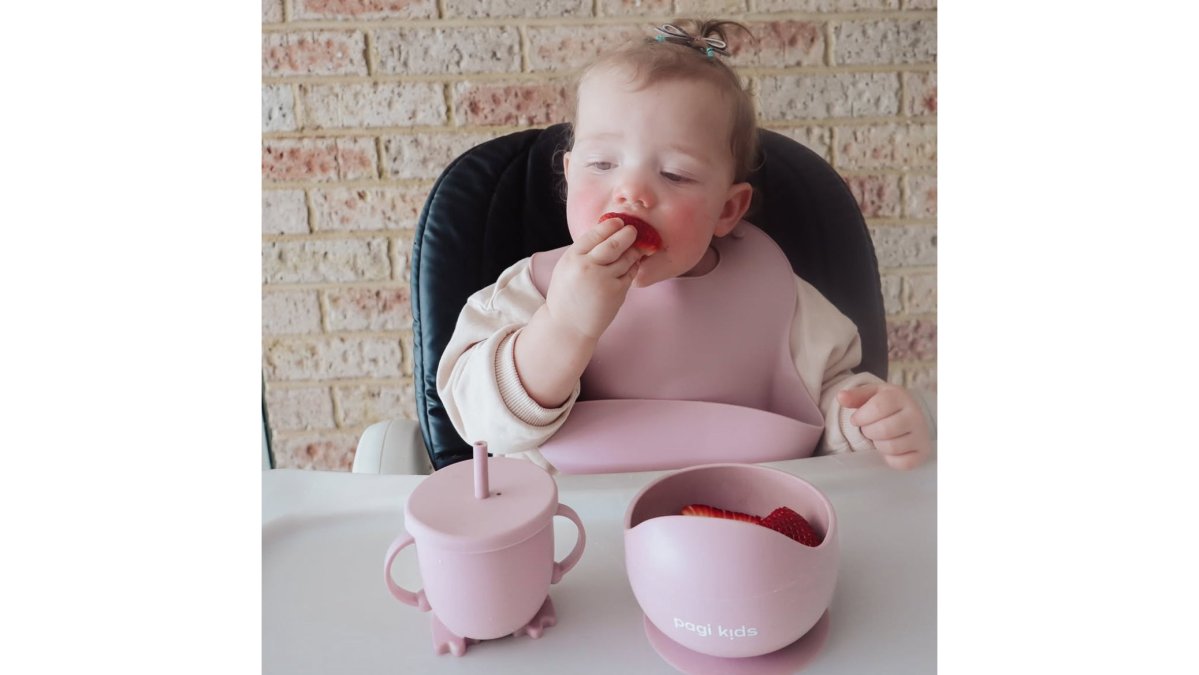
For a coordinated first-solids kit, the Pagi Kids Feeding Set covers the essentials in one purchase: a pocket bib with reinforced eyelets, a curved suction bowl for easier scooping, an ergonomic spoon soft on gums but firm enough to work, and a leakproof sippy cup with detachable lid and straw.
Junior Set ($44.95)
The Junior Set is a four-piece arrangement: suction plate, suction bowl, cup and spoon. It suits children from about six to eight months who are sitting confidently and starting solids, and is microwave and dishwasher friendly.
Ultimate Set ($44.95)
Where the Junior Set covers the basics, the Ultimate Set adds pieces that make cleanup and travel easier: plate with lid, suction bowl, bib, spoon and fork across six pieces. It suits families who want one matching setup for early spoon-feeding and independent toddler meals.
My First Solid Bundle ($60.00)
The My First Solid Bundle is the most complete option and the best value if you are starting from nothing. It includes the Pagi Kids Feeding Set, a Non-Grid Suction Plate, a silicone placemat and a Sip-N-Snack Cup, which switches between snacks and drinks.
How to Clean Silicone Baby Plates Without Damaging Them
Silicone is one of the easiest kitchen materials to clean, but two quirks catch parents out: it absorbs oil and scent more readily than glass or ceramic, and its suction base is the part most likely to be damaged by cleaning.
Everyday washing
Rinse plates, bowls and cups as soon as the meal ends. Silicone is non-porous, so food does not soak in, but oils and strongly coloured sauces bond to the surface if left to dry. A thirty-second rinse under warm water removes almost all of the risk.
Removing stains, smells and oil film
Oil film. Silicone can develop a slick, greasy feel even after washing, when cooking oils and fatty foods bond to the surface. A paste of bicarbonate of soda and warm water, rubbed on and left ten minutes before rinsing, lifts it.
Caring for the suction base
The suction base fails first if it is not looked after. Three habits keep it working:
- Do not wash the base with abrasive scourers. Micro-scratches break the seal.
- Do not leave the plate suctioned to a surface for long periods, especially in direct sun or near heat. Silicone can take a temporary set and the base may not sit flat afterwards.
- Check the base for trapped food or detergent residue before each use. A single grain of rice under the rim breaks the vacuum.
What to avoid
- Bleach and chlorine-based cleaners, which degrade silicone over time.
- Abrasive powders and steel wool.
- Sharp knives or scissors used directly on the plate, which can cut the surface and create places for food to hide.
- Leaving silicone in direct sunlight for extended periods, which can cause fading and stiffness.
- Stacking heavy items on top of a suction base in storage, which can deform it.
Suction Strength Testing: Why Plates Fail on Textured Trays
Most suction plates that "don't work" are being used on a surface they were never designed for. Suction works by pushing air out from under the base to create a vacuum, and that vacuum needs a smooth, flat, dry surface. Textured highchair trays, tray liners and tables with a grain break the seal before your baby even starts eating.
Surface Compatibility Guide
| Surface | Suction Performance | What to Do |
|---|---|---|
| Smooth plastic highchair tray | Strong hold | Wipe dry, press centre down firmly |
| Polished timber table | Strong hold | Ensure no oil or residue |
| Textured or matte tray | Weak or no hold | Use a smooth placemat underneath |
| Tray liner or fabric mat | No hold | Remove the liner before mealtime |
| Glass table | Strong hold | Check for crumbs before pressing |
If your highchair tray is textured, a smooth silicone placemat gives the plate something to grip and solves the problem permanently.
Divided vs Open Plates and Age-Appropriate Progression
Most buying guides treat divided versus open as a style preference. It is not. The right choice depends on where your child is in two separate skills: the pincer grasp (thumb and forefinger) and the ability to self-load a spoon or fork.
What each design actually does
A divided plate keeps foods physically separate. That matters for two reasons: many babies between six and ten months are still learning that different textures and colours are all food, and mixing them into one pile can cause refusal; and the raised walls give a baby a physical boundary to push food against when learning to scoop, which is easier than chasing food across a flat surface.
A stage-by-stage progression
Around six months (starting solids). Use a divided plate with shallow sections and a soft-tipped spoon. The goal is exposure and play, not volume. Sections let you offer two or three single-ingredient purees or soft finger foods without them running together.
Signs your child is ready to move on
You do not need to follow a calendar. Watch for these signals instead:
- They consistently lift the divided plate to their mouth rather than eating from it on the tray.
- They try to stir or mix foods across sections.
- They can get a spoon to their mouth with food still on it more often than not.
- They push the plate away when food touches across sections, or alternatively, they stop noticing the dividers at all.
- They can hold a cup and a spoon at the same time without dropping either.
The transition trap
Most parents move to an open plate too early, usually because the divided plate looks babyish. The result is a toddler who cannot yet keep food on a flat surface, more mess, and a return to the divided plate within a week.
Sustainability and End-of-Life for Silicone Tableware
Silicone is derived from silica found in sand, and unlike petroleum-based plastics it does not release toxic fumes during manufacturing or normal use. At the end of its life it can be converted back into inorganic, harmless ingredients rather than persisting in the environment the way plastic does, a meaningful difference for parents trying to reduce plastic in the home.
Conclusion
Getting a baby through their first year of solids is messy work, and the right equipment removes a surprising amount of daily friction. The priorities are simple: a base that grips your actual surface, a material that stays safe through heat and washing, and a size that matches where your baby is right now.
Frequently Asked Questions
Are silicone suction plates worth it for babies?
Yes, for most families starting solids. A suction base keeps the plate on the high-chair tray when babies push or lift, which means less food on the floor and more chances to practise self-feeding. Food-grade silicone is also soft on gums, free from BPA, PVC and phthalates, and safe in the microwave and dishwasher. Bub and Co plates start at $14.95, so the cost is modest for the daily mess it prevents.
How do I keep my baby's suction plate from moving?
Press down firmly in the centre of the base on a clean, dry, smooth surface. Suction works best on flat high-chair trays and tables, not on textured mats or surfaces with crumbs underneath. If the plate still lifts, wipe the base and tray, then press again. For extra grip, place a silicone placemat underneath first, then press the plate onto the mat.
Are silicone feeding sets dishwasher safe?
Most silicone feeding pieces are dishwasher safe, and the top rack is usually recommended to protect the shape and finish. Bub and Co sets, including the Junior Set and Ultimate Set, are microwave and dishwasher friendly. Rinse off heavy food residue before loading, and skip bleach or abrasive scrubbers, which can dull the surface and shorten the life of the silicone.
What materials should I avoid in baby feeding sets?
Avoid tableware that contains BPA, PVC or phthalates, since these are the materials parents most often want to keep away from food contact. Look for food-grade silicone and check the product listing for certification details. Bub and Co feeding sets are made from food-grade silicone free from BPA, PVC and phthalates, and are designed to handle heat and cold without leaching chemicals.
How do I choose the best suction plate for baby-led weaning?
Match the plate to your baby's stage. A divided plate with deep walls and a strong suction base suits babies around 6 months who are scooping and exploring. Open plates work better once toddlers can manage mixed textures. Consider a lid for outings, a set with a bowl and spoon for variety, and check that the suction base grips your specific high-chair tray before buying.
Product Safety Australia guidance on safe infant feeding products
Food Standards Australia New Zealand on food contact materials
Raising Children Network on starting solids and baby-led weaning
Leave a comment